2 October 2017

Julie Payette installed as Canada's new Governor General

Her Excellency the Right Honourable Julie Payette, Governor General and Commander-in-Chief of Canada. Photo credit: Sgt Johanie Maheu, Rideau Hall © OSGG-BSGG, 2017.

Julie Payette was today installed as Canada's 29th Governor General in a ceremony which took place inside the Senate Chamber on Parliament Hill in Ottawa. The ceremony started at 10.55 a.m. local time. According to the press release, the ceremony was to be followed by military honours and the inspection of a guard of honour outside of Parliament (12.15 p.m.). Ms. Payette will then lay flowers at the National War Memorial (1.45 p.m.), before arriving at Rideau Hall, the official residence and workplace of the governor general in Ottawa (1.55 p.m.). The day will conclude with an evening reception at the Canadian Museum of History (7 p.m.).

Payette replaced David Johnston, who was installed as Governor General on 1 October 2010. Johnston bid farewell at a ceremony last Thursday. His term was originally meant to expire in 2015, but was extended with two years. Payette, b. 1963, is a businesswoman and a former astronaut and engineer. She has been married twice and has one son.

In connection with Payette's installation, her coat of arms was unveiled.

© The Office of the Secretary to the Governor General. Copy of the version at gg.ca.

Arms: Per pale Azure and Sable a wing and in the canton the Royal Crown Argent.

Crest: A musical stave bearing the first notes of the second movement of Alessandro Marcello’s Oboe Concerto in D minor Sable; Motto: PER ASPERA AD ASTRA, meaning “Through hardship to the stars”.

Supporters: Two lynx Sable embellished Argent each wearing a collar set with laurel leaves Or and mullets Argent, and standing on the planet Earth Azure, its atmosphere Argent, charged with the Greek letter sigma (Σ) Argent.

More information about the coat of arms can be found at the website of the Governor General's Office.

The national coat-of-arms of Canada. Photo taken inside Parliament Hill in 2008.

 Parliament Hill, Ottawa.


 Rideau Hall, the official residence of the Governor General of Canada.

Well, just to prove that I have been there!

Last five photos: © 2008 Dag Trygsland Hoelseth.

25 September 2017

Sweden: Prince Gabriel's christening date set

The Swedish Royal Court announced today that the christening of Prince Gabriel, second son of Prince Carl Philip and Princess Sofia, will take place in the Royal Chapel at Drottningholm Palace on Friday 1 December 2017.

Prince Gabriel was born on 31 August 2017 at Danderyd Hospital. His name and title was announced on 4 September 2017. Prince Alexander, Prince Gabriel's elder brother, b. 19 April 2016, was also christened in the Drottningholm Palace Chapel (9 September 2016).

Princess Madeleine and Chris O'Neills children, Princess Leonore, b. 20 February 2014, and Prince Nicolas, b. 15 June 2015, were christened at Drottningholm on 8 June 2014 and 11 October 2015 respectively.

Crown Princess Victoria and Prince Daniel's children, Princess Estelle, b. 23 February 2012, and Prince Oscar, b. 2 March 2016, were on the other hand christened in the Royal Chapel at the Royal Palace in Stockholm. Princess Estelle's christening took place on 22 May 2012, while Prince Oscar's christening took place on 27 May 2016.

21 September 2017

Author Olav Duun's childhood home and grave

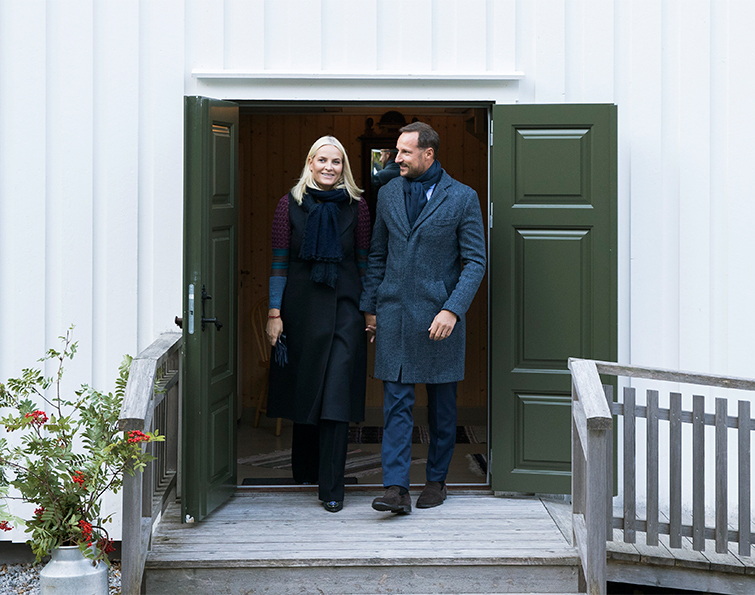
Crown Prince Haakon and Crown Princess Mette-Marit of Norway are currently paying a county visit to Nord-Trøndelag. Today they arrived at the island of Jøa in the municipality of Fosnes, where they among others visited the childhood of the author Olav Duun (1876–1939). On the Royal Court's official website you will find will find an article about today's visit to Jøa as well as photos from the country tour. See also NRK.no.

Duun was born at the farm Stein nearby, but lived at Øver-Dun farm at Ramnfjellaksla from he was 7-8 years old until he was 25. After he married Emma Møller (1881–1970) in 1908, he lived in Botne in Vestfold county (Botne became a part of Holmestrand municipality in 1964). He died in Tønsberg in 1939 and was buried at Dun Cemetery at Jøa near his childhood home.

I visited Jøa and Olav Duun's childhood home two years ago. Here are some photos of the farm Øver-Dun and Dun Church and Cemetery.


For no particular reason I never took photos of the entrance side of the house. But you you can see one photo of the Crown Prince couple in the door opening here.

 The Olav Duun memorial behind the farm house.


From the back side of the headstone you can actually spot Olav Duun's childhood home.


The first church at Dun was consecrated in 1900. It burnt down in 1944. The present church was consecrated 5 years later.

All photos: © 2015 Dag Trygsland Hoelseth. 

6 September 2017

Denmark: Prince Henrik suffers from dementia

The Danish Royal Court issued today the following press statement concerning Prince Henrik's health:
It is with deep regret that Her Majesty The Queen has asked the Lord Chamberlain to announce:

Following a longer course of investigation, and most recently, a series of examinations conducted during late summer, a team of specialists at Rigshospitalet has now concluded that His Royal Highness Prince Henrik suffers from dementia.

The diagnosis implies a decline in The Prince’s cognitive functional level. The extent of the cognitive failure is, according to Rigshospitalet, greater than expected considering the age of The Prince, and can be accompanied by changes in behaviour, reaction patterns, judgement and emotional life and may therefore also affect the interaction with the outside world.

As a consequence of the diagnosis, The Prince will further downgrade his future activities, just as patronages and honorary memberships will be considered.

It is the wish of The Queen and the Royal Family that The Prince will have the peace and quiet as required by the situation. 
During her new year's speech in 2015, Queen Margrethe announced that Prince Henrik had decided to retire from his official duties as of January 2016. A few months later he decided to stop using his title «Prince Consort» and reverted to being «just» Prince Henrik. On 3 August 2017 the Danish Royal Court informed that the prince had requested «not to be buried in Roskilde Cathedral as otherwise planned». The reason for his rather surprising decision was that he felt he was discriminated against because he had not received the title of king (consort) and thus felt he was not on equal foot with his wife the queen. Following the press release, he made comments to the media saying among others that the queen had made a fool of him. Prince Henrik has been occupied with the idea of being titled as king consort for quite some time, but his rather erratic behaviour in August made many observers feel that something was wrong with him. Although one could understand the reasoning behind his demands, his way of punishing his wife was uncalled for. In other words, today's press release doesn't come as a big surprise, and his health situation obviously explains his behaviour to a large extent. It is just sad that the court didn't protect him better back in August, and equally sad that the media didn't follow the Danish set of principles concerning press ethics, as it was obvoious to most people that the prince needed to be protected against himself.

I also hope not only that the media now will respect Prince Henrik's need for peace and quiet, but also that the public will also remember his many years of tireless work for the good of Denmark.


4 September 2017

UK: The Duke and Duchess of Cambridge are expecting their third child

Just before the name of Prince Gabriel of Sweden was announced in the Council of State at Stockholm Palace today, the British Royal Court at Kensington Palace informed that Catherine, the wife of Prince William, Duke of Cambridge, was pregnant again:
The Duke and Duchess of Cambridge are expecting their third child

Their Royal Highnesses The Duke and Duchess of Cambridge are very pleased to announce that The Duchess of Cambridge is expecting their third child.

The Queen and members of both families are delighted with the news.

As with her previous two pregnancies, The Duchess is suffering from Hyperemesis Gravidarum. Her Royal Highness will no longer carry out her planned engagement at the Hornsey Road Children's Centre in London today. The Duchess is being cared for at Kensington Palace.
As far as I know no information has been revealed about the due date, but obviously the duchess is less than 12 weeks pregnant, so the baby will be born some time in the spring of 2018.

The ducal couple's first child, Prince George, was born in 2013, while the second child, Princess Charlotte, arrived in 2015.

Postscript 19 October 2017: Kensington Palace released the following statement via its Twitter account on 17 October 2017: «The Duke and Duchess of Cambridge are delighted to confirm they are expecting a baby in April 2018.»

Updated on Thursday 19 October 2017 at 10 p.m. (postscript added).


Sweden: HRH Prince Gabriel Carl Walther, Duke of Dalarna

In the Council of State held at Stockholm Palace today it was announced (*) that Prince Carl Philip and Princess Sofia's son, who was born on Thursday 31 July 2017, had received the name Gabriel Carl Walther. It was also announced his first given name Gabriel was to be his call name. He had also received the title Duke of Dalarna.

When I commented on the name possibilities on Thursday, I said that everything was possible. That was why I argued, with my tongue in cheek, that Alfred was a good alternative for the newborn prince. It would go well together with his brother Alexander's name  as well. I was certain, however, that Folke would be one of the names, as the three earlier princes of the present generation – Nicolas (Paul Gustaf), Oscar (Carl Olof) and Alexander (Erik Hubertus Bertil) – all had got one of their names from their grandfather King Carl Gustaf Folke Hubertus. But I was wrong on that as well.

In the end no-one had guessed Gabriel for the baby prince's call name. No members of the Bernadotte family have the name Gabriel. But in the European Royal Family we have Prince Gabriel of Belgium – second child of King Philippe – and Prince Gabriel of Nassau, eldest son of Prince Louis. So in other words not a tradtional Swedish royal name, but something the parents opted out of personal preference. They might have felt that as Prince Gabriel was far down in the line of succession, they were less bound by tradition. Then again, Crown Princess Victoria and Prince Daniel were not so committed to royal traditions when they named their first child Estelle... Prime minister Stefan Löfven said that the prince «without any doubt was a little Gabriel», whatever he meant by that.

Gabriel is a common name in Sweden, but not among the most popular names. According to Statistiscs Sweden, 341 boys received the name Gabriel last year, which resulted in a 42nd place. All in all 17 709 men in Sweden have the name Gabriel, while 10 297 men has Gabriel as their call name.

It should be added that there have been a few surprises earlier as well. Just think about Prince Sigvard and Prince Lennart. The name Gabriel, even though it is not a traditional Swedish royal name, will work well, and it goes well together with Alexander too, I think.

The second name Carl is of course a very popular royal name in Swedish history. It is part of the current king's name, and is also the second name of Prince Gabriel's first cousin Prince Oscar. The third name Walther obviously comes from Queen Silvia's father Walther Sommerlath (1901–1990). One of her brothers also has the name Walther.

Many had guessed that Prince Gabriel would receive the ducal title of Dalarna, because his mother Princess Sofia grew up there. Then again, so did many before Prince Alexander's title was announced. As Trond Norén Isaksen pointed out in his blog article today, it was actually «the first time that such personal connections are taken into consideration for the choice of dukedom». Isaksen wrote, by the way, an excellent article on Swedish Royal Dukedoms in Royalty Digest Quarterly no. 2, 2016.

Prince Gabriel is the third member of the Bernadotte dynasty to receive the title Duke of Dalarna. Previous dukes of Dalarna were Prince August (1831–1873) and Prince Carl Johan (1916–2012) until he lost his titles in 1946.

Following the birth of Prince Gabriel, the line of succession to the Swedish throne is as follows:
  1. Crown Princess Victoria (1977)
  2. Princess Estelle (2012)
  3. Prince Oscar (2016)
  4. Prince Carl Philip (1979)
  5. Prince Alexander (2016) 
  6. Prince Gabriel (2017)
  7. Princess Madeleine (1982)
  8. Princess Leonore (2014)
  9. Prince Nicolas (2015)
(*) English version of the announcement.

Updated on Tuesday 5 September 2017 at 09.30 (subject title standardization).

31 August 2017

Royal birth in Sweden: A son for Prince Carl Philip and Princess Sofia

The second child of Prince Carl Philip and Princess Sofia was expected to take place in September, but arrived already today. The Marshal of the Realm released the following press statement earlier today:
Announcement from the HE The Marshal of the Realm

The Office of The Marshal of the Realm is delighted to announce that HRH Princess Sofia gave birth to a healthy child Thursday the 31 August 2017 at 11.24am at Danderyd Hospital.

Both mother and child are in good health.

Svante Lindqvist
Marshal of the Realm
Just like when the newborn baby's brother Prince Alexander was born, the sex of the child was not revealed until Prince Carl Philip held a press conference. That event took place at Danderyd Hospital around 3 p.m., and the court released another press statement:
Prince Carl Philip and Princess Sofia have had a son

On Thursday 31 August at 11.24 am, Princess Sofia gave birth to a son at Danderyd Hospital in Stockholm.

Weight: 3.400 gram
Length: 49 cm

Both mother and child are in good health.

Prince Carl Philip was present at Danderyd Hospital throughout the birth. In the afternoon, Prince Carl Philip met the media at Danderyd Hospital.
Just like when Prince Alexander and Prince Nicolas (the second child of Princess Madeleine and Chris O'Neill) were born, midwife Anna Ståhl and birth doctor Sophia Brismar Wendel assisted the birth.

The newborn prince is no. 6 in the line of succession to the Swedish throne, after his brother Prince Alexander, but before his aunt Princess Madeleine. The prince is King Carl Gustaf and Queen Silvia's fourth grandson and sixth grandchild.

The happy event was marked by a salute – 21 shots – from the salute stations in Boden, Härnösand, Karlskrona and Gothenburg at 6 p.m.

The court has also informed that a Council of State, in which the name and ducal title will be announced, and a service of thanksgiving («Te Deum»), will take place on Monday 4 September 2017 at the Royal Palace.

The name guessing has of course already started. It has been rather difficult to predict the names of the royal babies in Sweden. Prince Oscar, the son of Crown Princess Victoria and Prince Daniel, was perhaps the exception. So it is not easy to say what to expect. Everything is possible! I have said many times before that my personal preference would be a traditional Swedish royal name – and now I am first of all thinking about the name to be used daily – or at least a traditional European royal name. Alternatively a name with Swedish/Norse roots. So I was actually quite pleased with choice of the name Alexander for Prince Carl Philip's eldest son. I have read that many have mentioned William – or Wilhelm – as a possibility. I agree that the name would go well together with Alexander. In the Facebook group Royalty Digest Quarterly I suggested – just for fun, mind you – the name Alfred and the ducal title Dalarna. At least Alfred, Duke of Edinburgh, was a distant relative of the newborn baby. And I think Alfred would go well with Alexander. I am confident, however, that I will be wrong on at least one of the guesses, probably on both accounts.

What about the other names? An interesting point, as made by Robert Warholm at the Facebook group Kungligt forum back in 2016, is that the three earlier princes Nicolas (Paul Gustaf), Oscar (Carl Olof) and Alexander (Erik Hubertus Bertil) all have got one of their names from their grandfather King Carl Gustaf Folke Hubertus. So I think that we can expect Folke as one of the given names. Princess Sofia's grandfathers were named Stig and Janne Herbert, just to mention it. So, how about Alfred Wilhelm Herbert Folke?!

Prince Carl Philip and Princess Sofia could be influenced by the current trends. According to Statistics Sweden, these were the most popular names for the boys born in 2016:
  1. Oskar 879
  2. Lucas 864
  3. William 850
  4. Liam 790
  5. Oliver 700
  6. Hugo 688
  7. Alexander 668
  8. Elias 664 
  9. Charlie 650 
  10. Noah 627