Showing posts with label cemeteries and graves. Show all posts

15 September 2026

Norway: Funeral service for Princess Astrid, Mrs. Ferner to be held on 23 September 2026


An older photo of Ris Church. Photo: The National Library (public domain).

The Norwegian Royal Court announced today that the funeral service for Princess Astrid, Mrs. Ferner, who died last Friday 11 September, 94 years old, will take place at Ris kirke (Ris Church) in Oslo on Wednesday 23 September 2026 at 1 p.m.


Ris Church. Photo: © 2021 Dag Trygsland Hoelseth.

The church service will be broadcast and made available for Norwegian media. Ris Church was consecrated in 1932 and has today around 500 seats.

Princess Astrid's last resting place is expected to be next to her husband at Ris urnelund (Ris Urn Garden) in Oslo.

Ris Urn Garden was opened in 1957. As the name suggests the cemetery is a memorial garden with name plaques and urn graves only. 


26 August 2026

Sweden: Graves of Princess Désirée and Silfverschiöld family members, Lagmansered church ruins, Trollhättan municipality

Grave of Princess Désirée, Baroness Silfverschiöld (1938–2026).

Last Friday, while on my way to a genealogy conference (Släktforskardagarna 2026) in Borås, I made a short stop at the Lagmansered church ruins in the municipality of Trollhättan. Next to the ruins lies a small cemetery which has a seperate section for the baronial family of Silfverschiöld, whose principal seat is at Koberg Castle not far away.

Princess Désirée, an elder sister of King Carl XVI Gustaf of Sweden, died in January this year and was later interred at the cemetery next to her husband Baron (Friherre) Niclas Silfverschiöld (1934–2017). Her grave plate has not been put in place yet, so I will have to visit the cemetery again another time, maybe next year when I plan to attend Släktforskardagarna 2027 in Jönköping. Naturally I also took photos of the other Silfverschiöld graves before I took off again.

There used to be a stave church built at Lagmansered farm in 1465. It was burned down by the Danes in 1612. A new church was erected during the years 1639–1647, but it was destroyed by fire several times, and afte the last fire in 1929 the community decided to erect a new church at another location closer to Koberg. The new church also has a cemetery, so please have this in mind if you wish to visit the Silfverschiöld graves as they are, as already mentioned, situated in the cemetery at the ruins of the old church.


Her name has oddly enough been misspelt (it should be Désirée, not "Désireé").


Grave of Baron (Friherre) Niclas Silfverschiöld (1934–2017), husband of Princess Désirée.


Grave of Baron Otto Silfverschiöld (1871–1951), grandfather of Niclas.


Grave of Baroness Ingeborg Silfverschiöld, née vom Horn (1873–1953), wife of Otto.


Grave of Baron Carl-Otto Silfverschiöld (1899–1955), father of Niclas.


Grave of Baroness Madeleine Silfverschiöld, née Bennich (1906–1994, first wife of Carl-Otto and mother of Niclas.


Grave of Ambassador Carl Swartz (1920–2008), who was married to Niclas' elder sister Ulla Margareta Silfverschiöld, b. 1932.


Grave of Ebba Ribbing, née Baroness Silfverschiöld (1873–1914), younger sister of Otto, b. 1871.


Grave of Tekla Johansson (1883–1969), who had the title of Kammarjungfru - I suppose that she was employed at Koberg.


The section with the Silfverschiöld graves.


The ruins of the church which was destroyed by fire in 1929.


Updated on Thursday 17 September 2026 at 11:21 (name of Ambassador Swartz corrected).

5 February 2026

Sweden: Princess Désirée's funeral service to take place on 19 February 2026

The Swedish Royal Court announced today that the funeral service for Princess Désirée, who died on 21 January 2026, will take place in the Royal Palace Church in Stockholm on Thursday 19 February 2026. After the funeral service the king will held a reception in Princess Sibylla's Apartment at the Royal Palace. The burial will take place at Koberg, but the time has not been disclosed. As mentioned earlier, Princess Désirée's husband Niclas Silfverschiold (1934-2017) is buried with other family members at Lagmansered Cemetery not far from Koberg Palace in Trollhättan municipality.

30 April 2024

Royalty Digest Quarterly no. 1, 2024


The latest issue of Royalty Digest Quarterly (no. 1, 2024) was waiting for me in the mailbox when I returned on 7 April 2024 from my visit to Tanzania. Since my return I haven't had that much time for blogging, but obviously I had to finish reading RDQ before I could start commenting.

The front cover shows a photo of the Ansbach Residence (Residenz Ansbach), also called Markgrafenschloss (Margrave's Palace). The choice of photo tells that this issue's Family Album will cover The Margraves of Brandenburg-Ansbach. I will return to the article later in the blog. 

Main contents:

  • Olivier Defrance: A Life Without Tenderness. Princess Marie Louise of Bourbon-Parma. [Part] 1, pp. 1–10
  • Martijn Arts: Princess Alexandra Victoria of Schleswig-Holstein-Glücksburg. A Princess in a Caravan, pp. 11–15.
  • Elizabeth Jane Timms: Friedrich Wilhelm of Hesse (1870-1873), pp. 16–22.
  • Ted Rosvall: The Margraves of Brandenburg-Ansbach. A Family Album, pp. 23–35.
  • Susan Symons: The Last Margrave of Brandenburg-Ansbach, pp. 36–41
  • Ove Mogensen: Tombs, Graves and Monuments in Prussia, pp. 42–51.
  • Coryne Hall: Little-known ROYALS. Princess Henriette of Belgium, Duchess de Vendôme, pp. 52–53.
  • David Horbury: Queen Elizabeth II and Greece, pp. 55–60.
  • Ted Rosvall/Anne-Karin Schander: Royal Bustards. The Princes of Lapland. King Oscar I and Emilie Högqvist, pp. 61–62.
  • The World Wide Web of Royalty, p. 64 [this time including news about/from Albania, Fürstenberg, Italy, Luxembourg, Romania, Schaumburg-Lippe and Württemberg].
On p. 63 there is an ad for the royal history conference in Leeuwarden, the Netherlands, in October. I have paid for the flight and conference fee and got a hotel room reservation, so I look very much forward to the conference and hope to see as many old (and new) friends and acquaintances as possible. Go here for more details about the conference. 

The shocking abdication of Queen Margrethe II in January this year is the topic of Ted Rosvall's  Editor's Corner. He gives examples of abdications in other European countries and writes that "[...] in the Nordic countries, Margrethe's decision may be seen as an innovation, even though there was in fact a precedence. In 1654, Queen Christina of Sweden, actually did the same." That is absolutely correct. What Rosvall didn''t mention, was the abdication of the Danish King Erik III Lam in 1146. We are of course only talking about voluntary abdications. In Norway there were abdications in 1814 (King Christian Frederik) and in 1905 (King Oscar II), and neither had much choice in the matter. I only hope that Queen Margrethe's choice will not be followed up in the other Nordic monarchies.

The historian Oliver Defrance, with the colloboration of Joseph van Loon and Damien Bilteryst, has written about Princess Marie Louise of Bourbon-Parma (1870–1899), the first wife of of Prince and later King Ferdinand of the Bulgarians (1861–1948). The writers tell that they among others have based their article among others on an archive which has been little used until now : "[...] we have reread the existing works – old and new – on the Court of Bulgaria. We have gone trhough the press of the period, often rich with information, and we have made small surveys in an archive which has been little used until now: the Fonds Coburg, kept in the State Archives in Vienna". The result is a good and detailed biographical sketch of Princess Marie Louise, and I am already looking forward to part II.

I have often commented on the choices Coryne Hall has made for her column Little-Known ROYALS. I wonder if Princess Alexandria Victoria of Glücksburg (1887–1957) would also have been a good candidate. Of course my question marks some times tell as much about my own knowledge level. More important is that Martijn Arts has written an informative and amusing article about Princess Alexandria Victoria, the second eldest daughter of Duke Friedrich Ferdinand of (Schleswig-Holstein-Sonderburg-)Glücksburg (1855–1934) and Princess Caroline Mathilde of (Schleswig-Holstein-Sonderburg-)Augustenburg (1860–1932, the latter a niece of Empress Augusta Victoria, wife of Empreror Wilhelm II, while the former was a cousin of KIng Frederik VIII of Denmark. Princess Alexandria Victoria married Prince August Wilhelm of Prussia (1887–1949) in 1908 and divorced him in 1920. They had one child, Prince Alexander Ferdinand (1912–1985). The princess then married Arnold Rümann (1884–1951) in 1922, but also this marriage ended in divorce. She had a long career as an artist and for some time traveled around in the USA in a caravan. She lost all her paintings when Russia occupied the area where they were stored during WW2. I wonder how talented she really was and how much one would have to pay for any paintings that still exist? I note that one of her works was put on auction last year.

Royalty Digest Quarterly has covered all the all the still existing reigning and non-reigning royal and princely houses of Europe in the article series A Family Album and now it seems that houses that for various reasons have died out will also be covered. In this issue we learn more about The Margraves of Brandenburg-Ansbach. Somewhat confusing is the fact that the principality was also referred to as a margraviate and that the head was a margrave. There might be some historical details here that I have missed. Anyway, the last reigning Prince and Margrave (!), Karl Alexander (1736–1806), who was also sovereign of Brandenburg-Bayreuth, sold his principalities to King Friedrich Wilhelm II of Prussia in 1791. The childless margrave then moved to England with his second wife. As usual the family album gives a short introduction as well as quite a few photos/paintings – 55 in all (if a photo of  the Royal Family of Great Britain containing as many as 9 portraits should be counted as 9, and not just 1) – of various family members, palaces and tombs. The most famous descendant was Margravine Karoline of Brandenburg-Ansbach (1683–1737), who in 1705 married Georg Augustus of Hannover, who became King George II  of Great Britain and Ireland in 1727. One page 35 there is a select family tree of the house of Brandenburg-Ansbach.

The expert on German palaces, Susan Symons, then follows up with the article The Last Margrave of Brandenburg-Ansbach. The article, however, also gives many details about the above-mentioned Karoline/Caroline and even about Kaspar Hauser, who claimed to be a lost prince and the rightful ruler of Baden, because there is a memorial to him in the gardens of Ansbach Palace. When the former margrave moved to England after he had sold his principalities, he bought Brandenburgh House at Fulham, London as well as Benham Park near Newbury in Berkshire. It was at the latter country home that the margrave died in 1806. According to the Wikipedia article, "a memorial in St Mary's Church in Speen, simply records "In Memory of the Margrave of Anspach, who died at Benham 5th January 1806", but it doesn't say exactly where he is buried. Same thing could be asked about his wife Elizabeth, Princess Berkeley (b. London 1850–d. Naples, Italy 1828), née Lady Elizabeth Berkeley and formerly married to the 6th Baron Craven. The Wikipedia article about her, however, state that she was buried in the English cemetery in Naples. As for Brandenburgh House, it was demolished some time after the property was sold in 1822, and today the property, called Fulham Reach, consists of several buildings with luxury apartments. Not the worst place to live, I guess.


The Royal Mausoleum in Charlottenburg Palace Park, Berlin. © 2008 Dag Trygsland Hoelseth.


Grave of Queen Louise of Prussia, née Princess of Mecklenburg-Strelitz (1776–1810). © 2008 Dag Trygsland Hoelseth.


Grave of Friedrich der Grosse/Frederick the Great at Sanssouci, Potsdam. © 2011 Dag Trygsland Hoelseth.

The reason for including the grave photos above is of course due to Ove Mogensen's very informative article Tombs, Graves and Monuments in Prussia. Is there any royal burial place he has not been to?  I visited Charlottenburg Palace and the royal mausoleum (Luisenmausoleum) in February 2008. As far as I remember the main hall with the sarcophaguses was closed at the time due to renovation, so I could only visit the crypt, but that was of course where the royals were actually buried. I would have to return one day to see more of Berlin and Potsdam as well as the many burial places. I visited the crypt in Berlin Cathedral in 2011, so I might return with a blog article from that visit another time.

There are so many interesting articles in this issue, but I choose not to comment on all of them. But I have enjoyed reading them all, and cannot recommend a subscription enough! Information about Royalty Digest Quarterly can be found at its editor's website Royalbooks.se. See earlier presentations of RDQ here. See also its Facebook page. 

10 January 2023

My Genealogical Year of 2022

Last week I wrote an article about my published articles and Slektshistoriewiki contributions in 2022. But of course there is more to a genealogical year than how many articles one has written during a year. One could also mention trips to see places you descend from, churches linked to your own family or other familes you have been researching, family graves, family reunions, genealogy conferences etc. And of course last, but not least, genealogical discoveries! Any brick wall breakings?

So how should I summarize my genealogical year of 2022? The pandemic caused many events to be cancelled or postponed. Norsk Slektshistorisk Forening (NSF) – the Norwegian Genealogical Society in English – traditionally hosts Genea-LAN – LAN-party for genealogists – once a year. The 2021 was called off due to the pandemic, but in March 2022 the situation was much better, so in the weekend of  26–27 March around 30 genealogists gathered in the society's library in Lørenskog just outside Oslo, the capital of Norway. The aim is to do research non-stop from 11 a.m. Saturday morning to around 3 p.m. on Sunday. Many work on their own projects, but also give time to help others solving their challenges. There are lectures, quiz and plenty of time to socialize. The first Genea-LAN party ever took place in 2012, and the event in 2022 was the ninth. Only the events in 2018 and 2021 were called off. It really was a nice weekend, and I look very much forward to the next LAN party, which will take place during the last weekend of January 2023.

The Norwegian Genealogical Society also invites to a genealogy get-together in the library every second Saturday except in the summer months and Easter. I have attended several of these Genealogial Saturdays during 2002, and I also attended the annual meeting on the last day of May. Unfortunately the NSF genealogical conference which was to take place in October was called off.

In May my family had visitors from California – my third cousin once removed Christy and her son Ryan on the Hoelseth side of my family – came to stay with us for almost two weeks. I had not seen them since I visited California in 2000, so it was really lovely to see them again.


On most of the weekdays they toured Oslo on their own, but I took a couple of days off to show them Sandefjord so that they could meet my parents and we also traveled to Åmot where the Holset farm is situated. The photo above shows the remaining buildings at the farm.


Holsethaugen («The Holset Hill») nearby, where there are law-protected graves from Iron Age. After the visit to Holset I also showed some my visitors some other family farms in the area and took them to the family grave at Åmot Cemetery before we traveled to Hafjell for the weekend. Before we returned to Oslo we also spent some time in Lillehammer. Christy and Ryan also celebrated the Norwegian constitutional day – 17th of May – with us.


In June the Norwegian Genealogical Society arranged a guided trip for the members to Finnskogen (literally «Forest of the Finns») on both side of the Norwegian-Swedish boarder, We visited several farms which were cleared and settled by Forest Finns during the late 16th and early-to-mid-17th centuries, and we had lunch at Karmenkynna hembygdsgård (museum) at Lekvattnet in the municipality of Torsby (photo above). To learn more about the Forest Finns, see the Wikipedia article. I don't have Forest Finn ancestry, but I have always been interested in the minorities living in Norway, and I feel I learnt a lot during the Finnskogen tour.


Yours sincerely at the Forest Finn farm of Juhola.


Time for the «genealogical tour of the year»! On 23 June I traveled with three other genealogists up to Sollia Church in the municipality of Stor-Elvdal. The church was built on the land of my 7-x-great-grandfather Engebret Jonsen Sollien (1697–1760). 


Inside the church there is a portrait made of my ancestor in 1745 by the artist Erich Wallin.


The Engebret Jonsen Sollien memorial at the Sollia Cemetery. Not the original grave/headstone, mind you. Vi visited numerous churches during the trip – besides Sollia we photographed the churches of Stor-Elvdal, Atneosen, Øvre Rendal (Rendalen municipality), Ytre Rendal (Rendalen municipality), Sjøli (Rendalen municipality) and Deset in Åmot municipality. I hope to include photos of these churches in a later blog article or at least in articles at Slektshistoriewiki, the Norwegian genealogy wiki.

We also stopped at several farms, including Deset søndre («Søgarden») in Åmot where the sister of my 4-x-great-grandfather Ole Tollefsen Holset (1789–1840), Ingeborg Tollefsdatter (1802–1860), lived with her husband Otter Knutsen. Ole and Ingeborg were great-grandchildren of Engebret Jonsen Sollien mentioned above. Finally we made a stop at Holset, which means that I managed to visit my ancestral farm twice this year. This time there were sheep grazing on the land. Fortunately of the friendly sort!


In July I made a genealogical discovery which ended in a small article. I wouldn't call it a groundbreaking discovery, but nevertheless great to have found one missing piece in the puzzle. I had known for many years that my great-great grandmother and ancestor no. 23, Johanne Lovise Ragnhildrød (1854–1946) became a widow around 36 years old when her husband, Gustav Anton Hansen (Helgerød), b. in Stokke in Vestfold in 1853, was lost at sea. From time to time I had tried to locate more information about him, but to no avail. The Norwegian National Library have among others scanned newspapers on its website and almost every day new items are added, which means that you have to remember to make new searches for your «brick wall ancestors» now and then. And this is what I did one wonderful summer day in July. This time I found a newspaper article from January 1891, containing extracts of the maritime declaration following the shipwreck of the bark Carricks, and where my great-great-grandfather Gustav was mentioned as one of the 10 seamen who had fallen overboard and drowned during a heavy storm in the Sargasso Sea on 1 December 1890. So now I know exactly what happened as well as the death date. Finally! The article about the bark and the shipwreck can be found here. In connection with this discovery I also found out that Louise and Gustav had a boy, Georg Ludvig, who was born in November 1882 and died in February 1883, 3 months old. Previously I had only registered one son as well as two daughters – my great-grandmother Gunda Helene (1879–1962) and her twin sister Anna Kristine. 


This summer my wife, daughter and I spent 15 days in France. First a week in La Grand-Motte and the second week in Cannes. The seaside resort of La Grand-Motte was built in the 1960s and early 1970s and many of the buildings are pyramidal in form. During our stay we made trips to Carcassonne, Avignon and Montpellier, but also had a few relaxing days on the beach. But of course I couldn't help myself – there was a cemetery in La Grande-Motte that had to be explored. Most of the headstones were like in other cemeteries in France, but of course some of the urn walls were shaped like a pyramid. Jean Balladur (1924–2002), the architect behind La Grand-Motte's pyramid buildings, is also buried at the cemetery. I might return with an article about  the cemetery later on.


Examples of La Grand-Motte's pyramids.


We spent the last day in Nice before returning to Norway. My wife and daughter went shopping while I went to the cemeteries! There are three cemeteries in the Caucade area in Nice – Cimetière de Saint-Marguerite, Cimetière Municipal de Caucade and Cimetière Orthodoxe Russe – and all within a walking distance from my hotel near the airport. It was a very warm and sunny day, so if you understand enough French to figure out how to get there by bus I would recommend it. I guess I would have figured it out if I really wanted to, but I really needed some exercise! The British Civil  Cemetery of Saint-Marguerite has graves of many British exiles and others. My only goal there was to find the grave of Charles Henry Spencer-Churchill (1828–1877), a grandson of the 5th Duke of Marlborough. The grave was almost hidden by a bigh bush, so someone needs to fix it up, as it wasn't easy to take a good photo of. If anyone wonders, Sir Winston Churchill (1874–1965) was a grandson of the 7th Duke of Marlborough, who again was a grandson of the 5th Duke of Marlborough, so here you roughly have the relationship between Charles Henry and Sir Winston, i.e. 3rd cousins twice removed. I hope I got that right ... There were many interesting graves at the British cemetery, but this will do for now.
 

My main goal for this cemetery excursion was to visit the Russian-Orthodox Cemetery, where quite a few exiled Russian royals and aristocrats are buried. All in all I took 180 photos from my visit there, but I will only publish a few of them. Just look at the view from the cemetery! Just breathtaking!


Grave of Prince Rostislav Alexandrovich of Russia (1902–1978) and his third wife Hedwig-Marie von Chappuis (1905–1997).


Tomb of Princess Catherine Dolgorukova, Princess Yurievskaya (1847–1922), the morganatic wife of Emperor Alexander II of Russia (1818–1881).


Grave of Princess Helen (Jelena) of Russia. née Princess of Serbia (1884–1962) (widow of Prince Ivan of Russia (1886–1918).


Obolensky family grave.


Grave of Prince Michel Obolensky (1912–1977) and Marivonne Obolensky, née Bourgeois-Gavardin (1915–1994).


Grave of Prince Michel Nicolaievitch Obolensky (1943–2009).


Grave of Prince Yaschwill (1931–2017), married to Princess Yaschwill, née Marie-France Dornberger (1939–). It should be possible to find more details about Prince Yaschwill, but that is not really the topic of this blog article. As said, I took 180 photos at the cemetery, but I can't include them all here. So many interesting family names ... 

I also walked through the municipal cemetery at Caucade. Even though I visited the cemetery on a Sunday, the office was open, and I was able to ask about a grave on behalf of a fellow Norwegian genealogist. It turned out that the persons I asked about were not buried there, but in a small town outside of Nice. 


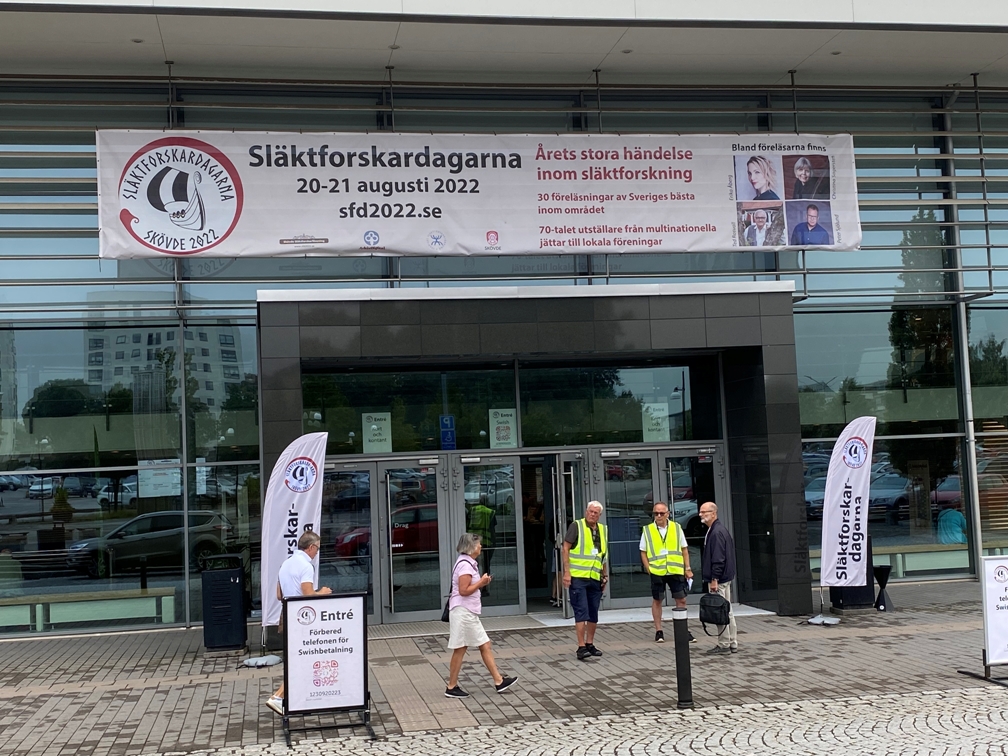
In August I attended Svenska Släktforskardagarna – the Swedish Genealogy Convention – in Skövde. A large number of Swedish genealogical societies had their own stand in the conference hall, and there were many interesting lectures.


In early October my family and I traveled to Oxford, England to visit friends. Oxford deserves several blog articles alone, as there is so much to explore there, but this time I will only mention a visit to the Holy Trinity Church at Headington Quarry outside Oxford. The author  C.S. Lewis (Clive Staples Lewis (1898–1963) is buried at the cemetery there, and inside the church you can see the Narnia window, which features images from C.S. Lewis's Chronicles of Narnia.


All 28 photos: © 2022 Dag Trygsland Hoelseth.

In November my parents celebrated their 80th birthdays together with family and friends, so I was able to see many family members I hadn't seen in a while. Finally, in December my eldest niece, who lives in Toronto, came home to celebrate Christmas and I was thrilled to be able to meet my great-nephew, who was born in July this year, for the first time!

Updated on Wednesday 11 January 2023 at 08:15 ("Norwegian National Archives" replaced by "Norwegian National Library", some missing words in the paragraph about Prince Yaschwill added).