Showing posts with label Ted Rosvall. Show all posts

20 August 2024

Royalty Digest Quarterly no. 2, 2024


The latest issue of Royalty Digest Quarterly - no. 2, 2024 – arrived in my mailbox on 4 July. It has been a busy summer, so I haven't much time to write a commentary until now.

The contents:
  • Olivier Defrance. A Life Without Tenderness. Princess Marie Louise of Bourbon-Parma II, pp. 1–10.
  • Martijn Arts: Sigismund and Charlotte Agnes of Prussia. From Palace to Nature, pp. 11–17.
  • Elisabeth Jane Timms: Losing Ludwig, pp. 18–28.
  • Bearn Bilker: The Princely House zu Wied – A Family Album, pp. 29–49.
  • Coryne Hall: Little-Known ROYALS. Prince Christian of Schaumburg-Lippe, pp. 50–52.
  • Stephen Bunford: The Pursuit of Pleasure - the Georgian Mistresses, pp. 53–62.
  • The World Wide Web of Royalty, p. 64.
The main cover photo is of Schloss Monrepos near Neuwied, one of the palaces of the Wied family, while the inserted photo is of  Princess (Fürstin) Marie, née Princess of  Nassau-Weilberg (1825–1902), who was married to Prince Hermann (1814–1836–1864). They were 4xgreat-grandparents of the current head, Prince Maximilian, b. 1999, if I have done my maths correctly.

Ted Rosvall opens his Editor's Corner this way: "The Duke of Sussex is now definitely "Persona non Grata" within the British Royal Family. This is hardly a secret and every new scandal seems to confirm it. Not to mention his easily hurt, spoiled and scheming duchess. Without being too harsh, one must probably conclude that their place in the cold is more than well deserved."

Well, we certainly agree that the ducal couple are "Persona non Grata". But I don't think it is fair to put all the  blame on them. The king, his brother and the media also have a share in my opinion, even if the couple has made the situation much worse by their TV interview, book publication etc. after moving to the States. It is all a very sad story ...

I feel that I have learned a lot about Princess Marie Louise of the Bulgarians, née Princess of Bourbon-Parma (1870–1899), wife of Prince Ferdinand (1861–1887–1918–1948) by reading Oliever Defrance's article, which was written with the collaboration of Joseph van Loon and Damien Bilteryst. What a sad marriage and what a selfish husband ...

Prince Sigismund (1896–1978), the second son of Prince Heinrich of Prussia (1862–1929) and a nephew of Emperor Wilhelm II, had an interesting life as a farmer in Guatemala and later in Costa Rica, together with his wife Princess Charlotte Agnes, née Princess of Saxe-Altenburg (1899–1989). I have read about them before, but it was a nice "return visit".

The article about king Ludwig II of Bavaria (1845–1886) by Elisabeth Jane Timms is based among others on the diary of Archduchess Marie Valerie (1868–1924), whose mother was Empress Elisabeth "Sissi" of Austria, née Duchess in Bavaria (1837–1898).

The main article of this issue is of course Bearn Bilker's Family Album of the House of Wied. The article follows the same pattern as previous family albums – a short introduction followed by a large collection of photos of various family members and then finally a genealogical table. Bilker could perhaps have mentioned Prince Wilhelm of Wied (1876–1945), who reigned as Prince (Mbret) of Albania for a short period in 1914, but at least it is mentioned in the genealogy (provided by Ted Rosvall, I gather?).

Prince Christian of Schaumburg-Lippe (1898–1974) was certainly not among the best-known members of royal Europe, and you would have to be very interested in royal history to know much about him these days. He was the son of Prince Friedrich (1868–1945), head of the Náchod branch, and Princess Louise of Denmark (1875–1906), the eldest daughter of Crown Prince, later King Frederik VIII) of Denmark (1843–1906–1912). Prince Christian, a first cousin of among others King Frederik IX of Denmark (1899–1947–1972) and King Olav V of Norway (1903–1957–1991), married his first cousin Princess Feodora of Denmark (1910–1975), eldest daughter of Prince Harald (1876–1949). Prince Christian and Princess Feodora's second son was the notorious Prince Waldemar (1940–2020), who caused so headlines of the years for the wrong reasons ...

When Stephen Bunford writes about "the Georgian Mistresses" he refers to the various Kings named George (of Hannover and the United Kingdom), but if you read the headline fast without thinking too much, you could easily wonder if the article was about mistresses from Georgia, and that would have made it more eccentric, wouldn't it?! Bunford doesn't hide the truth about King George IV: "[He] was an egotistical, romantic, dramatic, foolhardy, untruthful, narcistic, self-interested, self-absorbed sybarite." If you want to see the full list of George's over 70 known and alleged mistresses (and children) you should see Anthony Camp's website https://anthonyjcamp.com/pages/anthony-j-camp-nos-1-29.

Finally, the column The World Wide Web of Royalty this time brings you genealogical news of Hohenlohe-Öhringen, Lippe-Weissenfels, Schleswig-Holstein, Austria and Bavaria.

Information about Royalty Digest Quarterly can be found at its editor's website Royalbooks.se. See earlier presentations of RDQ here. See also its Facebook page

This article was last time updated on Tuesday 20 August 2024 at 21:20 (a link was corrected).

30 April 2024

Royalty Digest Quarterly no. 1, 2024


The latest issue of Royalty Digest Quarterly (no. 1, 2024) was waiting for me in the mailbox when I returned on 7 April 2024 from my visit to Tanzania. Since my return I haven't had that much time for blogging, but obviously I had to finish reading RDQ before I could start commenting.

The front cover shows a photo of the Ansbach Residence (Residenz Ansbach), also called Markgrafenschloss (Margrave's Palace). The choice of photo tells that this issue's Family Album will cover The Margraves of Brandenburg-Ansbach. I will return to the article later in the blog. 

Main contents:

  • Olivier Defrance: A Life Without Tenderness. Princess Marie Louise of Bourbon-Parma. [Part] 1, pp. 1–10
  • Martijn Arts: Princess Alexandra Victoria of Schleswig-Holstein-Glücksburg. A Princess in a Caravan, pp. 11–15.
  • Elizabeth Jane Timms: Friedrich Wilhelm of Hesse (1870-1873), pp. 16–22.
  • Ted Rosvall: The Margraves of Brandenburg-Ansbach. A Family Album, pp. 23–35.
  • Susan Symons: The Last Margrave of Brandenburg-Ansbach, pp. 36–41
  • Ove Mogensen: Tombs, Graves and Monuments in Prussia, pp. 42–51.
  • Coryne Hall: Little-known ROYALS. Princess Henriette of Belgium, Duchess de Vendôme, pp. 52–53.
  • David Horbury: Queen Elizabeth II and Greece, pp. 55–60.
  • Ted Rosvall/Anne-Karin Schander: Royal Bustards. The Princes of Lapland. King Oscar I and Emilie Högqvist, pp. 61–62.
  • The World Wide Web of Royalty, p. 64 [this time including news about/from Albania, Fürstenberg, Italy, Luxembourg, Romania, Schaumburg-Lippe and Württemberg].
On p. 63 there is an ad for the royal history conference in Leeuwarden, the Netherlands, in October. I have paid for the flight and conference fee and got a hotel room reservation, so I look very much forward to the conference and hope to see as many old (and new) friends and acquaintances as possible. Go here for more details about the conference. 

The shocking abdication of Queen Margrethe II in January this year is the topic of Ted Rosvall's  Editor's Corner. He gives examples of abdications in other European countries and writes that "[...] in the Nordic countries, Margrethe's decision may be seen as an innovation, even though there was in fact a precedence. In 1654, Queen Christina of Sweden, actually did the same." That is absolutely correct. What Rosvall didn''t mention, was the abdication of the Danish King Erik III Lam in 1146. We are of course only talking about voluntary abdications. In Norway there were abdications in 1814 (King Christian Frederik) and in 1905 (King Oscar II), and neither had much choice in the matter. I only hope that Queen Margrethe's choice will not be followed up in the other Nordic monarchies.

The historian Oliver Defrance, with the colloboration of Joseph van Loon and Damien Bilteryst, has written about Princess Marie Louise of Bourbon-Parma (1870–1899), the first wife of of Prince and later King Ferdinand of the Bulgarians (1861–1948). The writers tell that they among others have based their article among others on an archive which has been little used until now : "[...] we have reread the existing works – old and new – on the Court of Bulgaria. We have gone trhough the press of the period, often rich with information, and we have made small surveys in an archive which has been little used until now: the Fonds Coburg, kept in the State Archives in Vienna". The result is a good and detailed biographical sketch of Princess Marie Louise, and I am already looking forward to part II.

I have often commented on the choices Coryne Hall has made for her column Little-Known ROYALS. I wonder if Princess Alexandria Victoria of Glücksburg (1887–1957) would also have been a good candidate. Of course my question marks some times tell as much about my own knowledge level. More important is that Martijn Arts has written an informative and amusing article about Princess Alexandria Victoria, the second eldest daughter of Duke Friedrich Ferdinand of (Schleswig-Holstein-Sonderburg-)Glücksburg (1855–1934) and Princess Caroline Mathilde of (Schleswig-Holstein-Sonderburg-)Augustenburg (1860–1932, the latter a niece of Empress Augusta Victoria, wife of Empreror Wilhelm II, while the former was a cousin of KIng Frederik VIII of Denmark. Princess Alexandria Victoria married Prince August Wilhelm of Prussia (1887–1949) in 1908 and divorced him in 1920. They had one child, Prince Alexander Ferdinand (1912–1985). The princess then married Arnold Rümann (1884–1951) in 1922, but also this marriage ended in divorce. She had a long career as an artist and for some time traveled around in the USA in a caravan. She lost all her paintings when Russia occupied the area where they were stored during WW2. I wonder how talented she really was and how much one would have to pay for any paintings that still exist? I note that one of her works was put on auction last year.

Royalty Digest Quarterly has covered all the all the still existing reigning and non-reigning royal and princely houses of Europe in the article series A Family Album and now it seems that houses that for various reasons have died out will also be covered. In this issue we learn more about The Margraves of Brandenburg-Ansbach. Somewhat confusing is the fact that the principality was also referred to as a margraviate and that the head was a margrave. There might be some historical details here that I have missed. Anyway, the last reigning Prince and Margrave (!), Karl Alexander (1736–1806), who was also sovereign of Brandenburg-Bayreuth, sold his principalities to King Friedrich Wilhelm II of Prussia in 1791. The childless margrave then moved to England with his second wife. As usual the family album gives a short introduction as well as quite a few photos/paintings – 55 in all (if a photo of  the Royal Family of Great Britain containing as many as 9 portraits should be counted as 9, and not just 1) – of various family members, palaces and tombs. The most famous descendant was Margravine Karoline of Brandenburg-Ansbach (1683–1737), who in 1705 married Georg Augustus of Hannover, who became King George II  of Great Britain and Ireland in 1727. One page 35 there is a select family tree of the house of Brandenburg-Ansbach.

The expert on German palaces, Susan Symons, then follows up with the article The Last Margrave of Brandenburg-Ansbach. The article, however, also gives many details about the above-mentioned Karoline/Caroline and even about Kaspar Hauser, who claimed to be a lost prince and the rightful ruler of Baden, because there is a memorial to him in the gardens of Ansbach Palace. When the former margrave moved to England after he had sold his principalities, he bought Brandenburgh House at Fulham, London as well as Benham Park near Newbury in Berkshire. It was at the latter country home that the margrave died in 1806. According to the Wikipedia article, "a memorial in St Mary's Church in Speen, simply records "In Memory of the Margrave of Anspach, who died at Benham 5th January 1806", but it doesn't say exactly where he is buried. Same thing could be asked about his wife Elizabeth, Princess Berkeley (b. London 1850–d. Naples, Italy 1828), née Lady Elizabeth Berkeley and formerly married to the 6th Baron Craven. The Wikipedia article about her, however, state that she was buried in the English cemetery in Naples. As for Brandenburgh House, it was demolished some time after the property was sold in 1822, and today the property, called Fulham Reach, consists of several buildings with luxury apartments. Not the worst place to live, I guess.


The Royal Mausoleum in Charlottenburg Palace Park, Berlin. © 2008 Dag Trygsland Hoelseth.


Grave of Queen Louise of Prussia, née Princess of Mecklenburg-Strelitz (1776–1810). © 2008 Dag Trygsland Hoelseth.


Grave of Friedrich der Grosse/Frederick the Great at Sanssouci, Potsdam. © 2011 Dag Trygsland Hoelseth.

The reason for including the grave photos above is of course due to Ove Mogensen's very informative article Tombs, Graves and Monuments in Prussia. Is there any royal burial place he has not been to?  I visited Charlottenburg Palace and the royal mausoleum (Luisenmausoleum) in February 2008. As far as I remember the main hall with the sarcophaguses was closed at the time due to renovation, so I could only visit the crypt, but that was of course where the royals were actually buried. I would have to return one day to see more of Berlin and Potsdam as well as the many burial places. I visited the crypt in Berlin Cathedral in 2011, so I might return with a blog article from that visit another time.

There are so many interesting articles in this issue, but I choose not to comment on all of them. But I have enjoyed reading them all, and cannot recommend a subscription enough! Information about Royalty Digest Quarterly can be found at its editor's website Royalbooks.se. See earlier presentations of RDQ here. See also its Facebook page

7 February 2024

Royalty Digest Quarterly no. 4, 2023


I have written on the envelope which included the latest issue of Royalty Digest Quarterly (no. 4, 2023) that it arrived on 9 January 2024. So this time I am not too late with my commentary article, as compared to RDQ no. 3, 2023. The list of planned blog articles about various genealogy and history periodicals has fortunately become shorter, and I have managed to update my blog quite often so far this year as compared to last fall. Life is less hectic now, so I am able to focus more on my blog activities than earlier. Another reason is that Slektshistoriewiki, the Norwegian genealogy wiki which I am the editor of, has been taken down since 1 January due to program updating, and that work, which I am not involved with, has taken more time than expected. But this also means that I have not been able to update and write new articles on the wiki for a while. I look forward to returning to my editor responibilities and other contributions to Slektshistoriewiki, but I enjoy updating the blog as well. I have also started on a genealogy book project this year, but it is something that I plan to work on and off for quite some time. I might not get the book out before 2027 or 2028 because there is so much work to be done on it, and I have to work on other projects as well, and of course my family and work have to come first.

Anyway, here are the contents of the latest issue of RDQ:
  • Charlotte Zeepvat: The Prince House of Hohenlohe-Langenburg. A Family Album, pp. 1-22.
  • Susan Symons. Feodora of Hohenlohe-Langenburg and her sister, pp. 23–29.
  • Datiu Salvia Ocaña: The Spanish Hohenlohe-Langenburgs, pp. 30–36.
  • Elizabeth Jane Timms: Imperial Governess: Miss Throckmorton and Marie Valerie [, Part] II, pp. 37–46.
  • Stephen Bunford: Claims and counter-claims. Those who would be kings/queens, or think they should, pp. 47–53.
  • Katrina Warne: A Surfeit of Sophias, pp. 54–58.
  • Bearn Bilker: Christian, Fürst zu Bentheim und Steinfurt 1923–2023, pp. 59–62
  • The World Wide Web of Royalty. Births, marriages, deaths and other events in the Royal Families of Europe, p. 64.
On page 63 you will find information on the planned Royal Weekend conference in Leeuwarden, the Netherlands, which will take place on 11 October (evening) to 13 October  (afternoon) 2024. I very much plan to attend the conference and hope to see you all there! I have never been to that part of the Netherlands before, so it all looks interesting.

Charlotte Zeepvat, the former historical consultant to Royalty Digest Quarterly, has returned with a contribution titled The Princely House of Hohenlohe-Langenburg. A Family Album. As usual the readers get a short introduction to the dynasty, then follows a large number of illustrations (of palaces and members of the dynasty, 70 in all if I have counted correctly) and finally the readers can enjoy 5 pages with genealogy tables. The genealogy surveys become handy when reading the next two articles, which also cover members of the Hohenlohe-Langenburg. Susan Symons, who is known for her book series on German castles and palaces, has written a nice article about Princess Feodora of Leiningen (1807–1872), who in 1828 married Ernst I of Hohenlohe-Langenburg (1794–1860). Feodora was elder the half-sister of the British Queen Victoria (1819–1901).

To be honest, I didn't know too much about the Spanish Hohenlohe-Langenburgs, so the article was very useful to me. The already mentioned genealogy tables helped when reading the article, because the author lists lots of names! There is no list of sources at the end of the article, which I hope was a one-time mistake.

I wrote about Elizabeth Jane Timms' articles on Imperial Governess last month. I really enjoyed the two-part article.

The list of people with a claim to the present and former thrones of Europe is long. I think Stephen Bunford has made a good effort of presenting them all. Visited are United Kingdom (the Stuarts), Portugal, France, Austria, Russia, Spain, Romania, Italy, Saxony, Monaco and Bourbon-Two Sicilies. I don't understand why the author writes that «Does a monarch have the right to change succession rules? This was done in Denmark (disinheriting Prince Knud and allowing female succession), [...]», though. The question was settled by constitutional changes supported by a majority of the Danes in a referendum. It was not King Frederik IX's unilateral decision. 

There have been many royals named Sophia over the years. Katrina Warne tells the story of  seven of them. I take the opportunity to quote from the article's introduction: «In May 2007 Point de Vue published a royal family tree highlighting numerous royals named Sophia or Sophie or a regional variation of the name. The publication was prompted by the birth of Infanta Sofia of Spain, the younger daughter of King Felipe VI. A couple of years later my niece Sophie was born and as I was very pleased that she had been given a royal name I looked at the family tree again. I noticed that in one line of descent that there was a surfeit of royals named Sophia and that it included some interesting personalities.» The line begins with the Electress Sophia of Hannover (1630–1714) and ends with Sophie Dorothea of Württemberg (1759–1828), who took the name Maria Feodorovna when she married Emperor Paul I of Russia in 1776.  The above-mentioned Infanta Sofia of Spain is of course one of many descendants of the couple. 

Prince Christian of Bentheim and Steinfurt celebrated his 100th birthday on 9 December 2023. He died 3 days later. The article by Bearn Bilker was written prior to his death, so information about his death has probably been added by the editor, Ted Rosvall. The new head of the House of Bentheim and Steinfurt is Prince Christian's nephew and adopted son Prince Carl Ferdinand, b. 1977.

The genealogy column The World- Wide Web of Royalty then brings news from Austria, Liechtenstein, Russia, Saxony-Coburg and Gotha, Schleswig-Holstein, Schwarzenberg, Serbia, Bourbon-Two Sicilies and Hohenlohe-Öhringen.

Information about Royalty Digest Quarterly can be found at its editor's website Royalbooks.se. See earlier presentations of RDQ here. See also its Facebook page

30 January 2024

Royalty Digest Quarterly no. 3, 2023


The third issue of Royalty Digest Quarterly in 2023 was published some time last fall and should of course have been commented on a long time ago. There are two reasons for this lag – the first is that I focused so much on various genealogy projects last fall that I didn't blog much at all. The other is that I misplaced my copy of RDQ before I got the chance to read it. It was rediscovered in a bag I normally don't use around Christmas time. And so far this month I have written so much about the events in Denmark besides commenting on other periodicals. I now realize that I haven't commented on issue no. 2 from last year either. No, I haven't lost that copy, but I think the train has passed for commenting on it. Anyway, no. 3 has been read and it's on time to write a few words. 

Contents:
  • Marlene A. Eilers KoenigThe Wedding of Gusty and Louise, pp. 1–10.
  • Ted Rosvall: The Landgraves of Hessen-Homburg, pp. 11–20.
  • Susan Symons: The Princesses of Hessen-Homburg, pp. 23–30.
  • Elizabeth Jane Timms: Imperial Governess. Miss Throckmorton and Marie Valerie, pp. 31–41.
  • Ove Mogensen: Tombs, Grave and Monuments in Romania, pp. 42–48.
  • Ted Rosvall: A Double Jubilee in Sweden, pp. 49–55.
  • Ted Rosvall: Royal Bustards, p. 56.
  • Stephen Bunford: George III's illegitimate grandchildren, pp. 57–61.
  • Coryne Hall: Little-Known ROYALS. Princess Zorka of Montenegro, pp. 62–63.
  • The World Wide Web of Royalty, p. 64.
In other words plenty of articles worth reading. First one out is Marlene Koenig's article on the wedding of the then Crown Prince Gustaf Adolf of Sweden to Lady Louise Mountbatten in 1923. Crown Prince Gustaf Adolf, eldest son of King Gustaf V and Queen Victoria, née Princess of Baden, had earlier been married to Princess Margaret of the United Kingdom of Great Britain and Ireland, who died in 1920, only 38 years old. Margaret was the eldest daughter of the Duke of Connaught and the Duchess of Connaught, nee Princess Luise Margarete of Prussia. Lady Louise Mountbatten was born in 1889 as Princess of Battenberg, the second daughter of Prince Louise of Battenberg and Princess Victoria of Battenberg, née Princess of Hesse and by Rhine. As is well known, Prince Louis relinquished his his title Prince of Battenberg and style of Serene Highness in July 1917 and anglicised his family name to Mountbatten. In November 1917 Louis was created Marquess of Milford Haven. His eldest daughter Alice, mother of Prince Philip, was already married at the time, so only the three younger children stopped using their princely titles and assumed courtesy titles as children of a British Marquess. I make a point of this because it meant that Louise was not a princess in 1923, and the Swedish Act of Succession at the time said that a a Prince would lose his rights if he married «a private man's daughter», i.e. was not a royal or equal. Lady Louise would thus come into this category, but the matter was «solved» when the British prime minister at the time confirmed that she was a member of the British Royal Family and was included in the list of precedence at the court. Obviously the understanding ot the article in the Act of Succession was stretched a bit for the marriage to go ahead without consequences. But married they were, and upon Gustaf Adolf's succession in 1950 as King Gustaf VI Adolf, Crown Prince Louise became Queen of Sweden. She died in 1965, 75 years old.

Ted Rosvall then tells the story of the Landgraves of Hesse-Homburg (or Hesse-Homburg if you like), perhaps one of the less known houses of Hesse. The last Landgrave of Hesse-Homburg was Ferdinand (1783–1866), second youngest son of Landgrave Friedrich V (1748–1820) and Landgravine Karoline, née Princess of Hesse-Darmstadt (1746–1821). His elder brothers Friedrich, Ludwig, Philipp and Gustav had also been Landgraves, but none of them left a male heir to carry on the line. Besides the short presentation the article includes 35 illustrations of family members, palaces/castles and even a map.Thankfully Rosvall has also provided a «select family tree», which is useful when reading Susan Symon's article The Princesses of Hessen-Homburg. The said princesses were the five sisters of the above-mentioned landgraves who survived childhood. All in all Friedrich V and Karoline had 15 children (An Online Gotha lists 13 of them). Symons, whos known for her book series about German palaces and castles, gives a good outline of the princesses and their marriages and offspring.

Elizabeth Jane Timms's article Imperial Governess. Miss Throckmorton and Marie Valarie is based on among others the Throckmorton papers (correspondence etc.) kept in the Warwickshire County Record Office and the court archives in Vienna. Miss Mary Throckmorton (1832–1919) was a daughter of Sir Robert George Throckmorton, 8th Baronet and his wife, Elizabeth Acton, daughter of Sir John Francis Edward Acton, Baronet of Aldenham. Miss Throckmorton served as Governess to Archduchess Marie Valerie (1868–1924), youngest child of Emperor Franz Joseph (1830–1916) and Empress Elisabeth, née Duchess in Bavaria (1837–1898), from 1869 to 1874. In this first (of two) articles on the Imperial Governess we follow the lives of Marie Valerie and her former governess through the correspondence they kept. As I have written on so many occasions, I love these articles where you read about royalty through people who were employed at a court. The article is well written and well researched. And thankfully, as already mentioned, there is a second article on the relationship between the Archduchess and her former governess.

Ove Mogensen has traveled all over the world to visit and take photographs of tombs, graves and monuments of the many royal and princely houses and have written numerousn articles about these visits in RDQ. This time we learn about the graves of various members of the Romanian royal family in and outside Romania. This sort of articles is another – and good – way to learn more about royal history. And as always well illustrated

The editor of Royalty Digest Quarterly, Ted Rosvall, has contributed to several articles in this issue. In A Double Jubilee in Sweden, we learn both about the 500th anniversary of Gustav Vasa's succession to the Swedish throne and Carl XVI Gustaf's 50th anniversary as King of Sweden. The author also gives us a short presentation of the monarchs between 1523 and 2003. In his Royal Bustards series, Rosvall then tells the story of the Swedish singer Carl-Erik Olivebring (1919–2002), who might have been the illegitimate son of King Gustaf VI Adolf (also mentioned above). Her mother was a lady-in-waiting at the Royal Court in Stockholm, Judith Cecilia Serafia Andersson (1877–1924). The official records say that his father was a farmer named Lars Ersson, b. 1844. Other than the connection to the court, there is nothing that backs up the claim, other than that the singer had an «uncanny resemblance to some of the king's sons, especially Prince Sigvard and Prince Bertil». Oh well. 

Stephen Bunford follows up with a good discussion about and outline of King George III of Great Britain and Ireland's illegitimate grandchildren.

I have earlier questioned some of che choices for the series Little-Known ROYALS written by Coryne Hall, but of course it will depend how much knowledge you have about the present and former monarchies. Princess Zorka of Montenegro (1865–1890) was the eldest daughter and child of Prince Nikola, later King Nikola of Montenegro (1841–1860–1921) and Princess, latger Queen, Milena, née Vukotic (1847–1923). She married Prince Peter Karadjordjevic (1844–1921), who became King of Serbia in 1903, but by then Zorka had been dead for 13 years. I am not sure if she had been better known if she had lived longer and become Queen. One could say that the kingdom of Serbia is better known than the smaller neighbour kingdom of  Montenegro, but again it all depends on your knowledge. I think she fits the category, and anyway, Coryne Hall tells her story well.

The genealogical news included in the The World Wide Web of Royalty column are from events in July, August and September 2023, so they are a bit old now, but such records of events can be useful nevertheless. This time the readers are given news from the Imperial, royal and princely houses of Austria, Bavaria, Bourbon-Parme, Denmark (Rosenborg), France-Orléans, Schleswig-Holstgein and Württemberg.

If you are not already a subscriber to Royalty Digest Quarterly, please consider it! Information about the magazine can be found at its editor's website Royalbooks.se. See earlier presentations of RDQ here. See also its Facebook page.

4 April 2023

Royalty Digest Quarterly no. 1, 2023


The first issue of Royalty Digest Quarterly this year arrived just before the Palm weekend. The RDQ, which was started in 2006 as the successor to the British monthly publication Royalty Digest, is published four times a year. According to its frontpage RDQ is «a journal devoted to the history, genealogy and images of the Royal Families of Europe».

From the contents of the present issue:

  • Editor's Corner
  • Stephen Bunford: The Schleswig-Holstein Wars and Succession, pp. 1–6.
  • Marlene A. Eilers Koenig: The Marriage of Princess Maud and Lord Carnegie, pp. 7–16.
  • Elizabeth Jane Timms: Farewell in White. The Funeral of Queen Victoria, pp. 17–28.
  • Ted Rosvall: Hessen-Philippsthal & Hessen-Phillipsthal-Barchfeld. Two Family Albums, pp. 29–46.
  • Ove Mogensen: Tombs, Graves and Monuments in Bulgaria, pp. 47–52.
  • Ted Rosvall: What?, pp. 53–58.
  • Ted Rosvall: Book Review: Spare us! (review of Spare by Prince Harry, Duke of Sussex), p. 59.
  • Coryne Hall: Little-Known ROYALS. Grand Duchess Catherine Michaelovna of Russia, pp. 60–61.
  • Ted Rosvall: Royal Bustards, pp. 62–63.
  • The World Wide Web of Royalty, p. 64.
In his Editor's Corner Ted Rosvall is not impressed by  the way the Greek authorities handled the death and funeral service of the former King Constantine II of the Hellenes – and rightly so.

There are several interesting and readable articles in the present issue. I am not going to comment on them all. The cover photo shows Schloss Wilhelmsburg near Barchfeld and «it's creators», i.e. Landgrave Wilhelm of Hesse-Philippsthal-Barchfeld (1692–1761) and his wife Landgravine Charlotte Wilhelmine, née Princess of Anhalt-Bernburg-Hoym (1704–1766). The House of Hesse-Phillipsthal became extinct in 1925 following the death of Landgrave Ernst, while the House of Hesse-Phillipsthal-Barchfeld is still with us, and the current head is Prince Wilhelm, b. 1933. It is not often we hear about these two Hesse branches, so I am pleased that the editor decided to pay attention to them. Besides a very short introduction the readers can enjoy about 64 images (depending on how you count) of various family members and residences. In addition there are two genealogical tables.

Any relations to the royal family of Norway? Yes, among King Harald's many royal ancestors is Princess Sofie of Hesse-Philippsthal (1695–1728), daughter of the first Landgrave of Hesse-Phillipsthal, Philipp (1655–1721) and his wife Katharine Amalie, née Countess of Solms-Laubach (1654–1736). Sofie married in 1723 Duke Peter August of Schleswig-Holstein-Sonderburg-Beck (1696–1775). The connection then goes as follows:

Duke Karl Anton August (1727–1759) --> Duke Friedrich Karl Ludwig (1757–1816) --> Duke Friedrich Wilhelm (1785–1831), who in 1825 became Duke of Glücksburg --> Prince Christian of Glücksburg (1818–1906), who in 1863 became King of Denmark --> King Frederik VIII (1843–1912) --> Prince Carl (1872–1957), who in 1905 was elected King of Norway as Haakon VII --> King Olav V (1903–1991) --> King Harald V (1937–).

There are other connections, for instance from Princess Sofie's elder brother Karl I (1682–1770), whose daughter Charlotte Amalie (1730–1801) married Duke Anton Ulrich of Saxe-Meiningen (1687–1763). Their daughter Princess Charlotte (1751–1827) married in 1769 Hereditary Prince Ernest of Saxe-Gotha-Altenburg (1745–1804), later Duke Ernest II. From this couple the line goes: Duke Augustus of Saxe-Gotha-Altenburg (1772–1822) --> Princess Louise of Saxe-Gotha-Altenburg (1800–1831), wife of Duke Ernest I of Saxe-Coburg and Gotha --> Prince Albert of Saxe-Coburg and Gotha (1819–1861), later Prince of the United Kingdom --> King Edward VII of the United Kingdom (1841–1910) --> Princess Maud (1869–1938), from 1896 Princess of Denmark and from 1905 Queen of Norway --> King Olav V (1903–1991) --> King Harald V (1937–).

I visited Bulgaria for the first and so far only time in July 1991. I wish I had paid more attention to the royal graves in Sofia. At least I should have visited Prince Alexander's mausoleum. But it was a very short stay – I arrived by night train from Bucharest early on 17 July 1991 and left on the evening of 18 July by night train to Belgrade. I would love to see more of Sofia another time, and to visit other parts of Bulgaria as well. Anyway, Ove Mogensen gives as usual a good acount of the graves of the last two Bulgarian royal houses. 

So what lies behind the curious subject title What? Ted Rosvall discusses the birth of Johann Georg Heinrich Kleinecke in Silkerode in 1799 and his possible royal parents. Far from proven, but plausible.

In the series of Little-Known ROYALS (why capital letters, I wonder) Coryne Hall this time presents Grand Duchess (Grand Princess) Catherine (Ekaterina) Michaelovna of Russia (1827–1894), daughter of Grand Duke (Grand Prince) Michael Pavlovich of Russia (1798–1849) and Grand Princess Elena Pavlovna, née Princess Charlotte of Württemberg 1807–1873). Catherine married in 1851 Grand Duke Georg August of Mecklenburg-Strelitz (1824–1876).

In the new (?) series Royal Bustards the editor Ted Rosvall presents Johan Arthur Bäckström (1861–1941), a possible illegitimate son of King Oscar II (1829–1907). Finally, in The World Wide Web of Royalty the readers get genealogical news from the Imperial, Royal, Grand Ducal or Princely houses of Baden, France (Bonaparte), Greece, Lippe and Luxembourg. 

Information about Royalty Digest Quarterly can be found at its editor's website Royalbooks.se. See earlier presentations of RDQ here. See also its Facebook page.

12 January 2023

Royalty Digest Quarterly no. 4, 2022

The fourth and last issue of the Royalty Digest Quarterly in 2022 arrived just before Christmas. What a cover! The Albanian royal family. The red color is darker than the red color of the Albanian flag, but other than that it is perfect. I can't find any mentioning of who is who in the photo, but of course King Zog is in the middle together with four of his sisters, his mother Sadijé, née Toptani, and a nephew.

The article ALBANIA – the House of Zogu. Family Album is written by the Albanian Royal House expert Neil Rees and Ted Rosvall. The readers get the familiar introduction with a short history of Albania, including the short reign of Prince Wilhelm of Wied (I had forgotten that he is actually buried in the protestant church of Bucharest – I have been to Bucharest twice without knowing, so I would have to go another time!) and then the history of the short-lived Albanian kingdom and of the Royal House of Zogu. The photo album includes 40 images and in addition there is a family table as well. Some of the photos have been provided by the current head of the Royal House of Albania, Crown Prince Leka (b. 1982).

The Balkan monarchies have always interested me the most, and that certainly includes Albania. I have always wanted to see more of the country – so far I have only been on a day visit to the Northern city of Shkodër and the Rozafa castle ruins. I really wanted to go to Tirana when Crown Prince Leka married Elia Zaharia in 2016, but I was in Spain with my family at the time.

In 2009 I visited Cimetière de Thiais in Paris, France, where King Zog and some family membes were buried at the time. In 2012 the king's coffin was brought home to Tirana to be reburied in the Royal Mausoleum there. I would like to go to Tirana one day to visit the mausoleum and of course the city itself. And what about a few days at the beach of Sarandë, or maybe Vlorë?


The former grave of King Zog of the Albanians at the Cimetière de Thiais in Paris, France. Photo: © 2009 Dag Trygsland Hoelseth.

Over the years I have collected a few items connected to the  Royal House of Albania, one of them is the two-volume Oxhaku Famëmadh ZOGU. Album historik i përzgjedhur by Ramiz Lushaj (Shtëpia Botuese "Dardania", Tiranë, 1995). The two volumes are full of articles, documents and photos about King Zog and the Albanian Royal Family.  I am not bothered that most of the texts are in Albanian ... It is great to have the two volumes in my book collection.


But I am getting off track here. From the contents of the fourth issue:
  • Marlene A. Eilers Koenig: A Delphinium Wedding. The Marriage of Lord Louis Mountbatten and Edwina Ashley, pp. 1–8.
  • David Horbury: The Final Year. Queen Helen of Romania in 1947, pp. 9–20.
  • Stefan Haderer: Loyal to the bitter end. Archduke Albrecht of Austria, Duke of Teschen, pp. 21–28.
  • Neil Rees and Ted Rosvall: ALBANIA - the House of Zogu. Family Album, pp. 29–42.
  • Richard Jay Hutto: "Aunt Muriel – a Queen's Mentor, pp. 43–48.
  • Datiu F. Salvia Ocaña: Ladies' Royal Orders in Europe, pp. 49–56.
  • Ove Mogensen: Tombs, Graves and Monuments in Baden, pp. 57–59.
  • Coryne Hall: Little-Known ROYALS. Prince Francisco José of Braganza, pp. 60–61.
  • Ted Rosvall: Debate. The Perils of Change, pp. 62–63.
  • The World Wide Web of Royalty, p. 64.
The photo album was not the only article related to Albania. Queen Geraldine's "Aunt Muriel" was Muriel White (1880–1943) and married to Geraldine's father's first cousin Count Hermann von Seherr-Thoss (1879–1959) (and not Count Hans Christoph von Seherr-Thoss, as the article says, although he had those given names as well). Muriel followed Geraldine to Tirana when she got engaged and married to King Zog and was present for the birth of Zog's son Leka in 1939. Muriel has a really interesting story of her own, and the author of the article, Rick Hutto, is currently writing a book about her. 

In his Editor's Corner Ted Rosvall has this time compiled a list of the oldest European royals to succeed to the throne. Charles III of the United Kingdom was 73 when he succeeded, for instance, but he was not on top of the list ...  Missing in the list was Grand Duke Adolph of Luxembourg (1817–1905), who was also 73 when he succeeded to the throne in 1890, although a few months younger than Charles was at the time of succession. Rosvall focuses on kings in his list, but includes Grand Duke Ludwig I of Baden, so why not Adolph as well? Because he didn't inherit the throne of Luxembourg from his father, but due to the different succession laws that dissolved the personal union between Luxembourg and the Netherlands in 1890?

There are many good and well-researched articles in this issue, including Marlene Koenig's wedding article and David Horbury's detailed account of Queen Helen of Romania's experiences in 1947. I didn't know much about Archduke Albrecht of Austria (1817–1895), so I enjoyed that article as well. Ladies' Royal Orders in Europe was also an interesting read, although I miss a list of sources at the end of the article.

The column The World Wide Web of Royalty this time included genealogical news about the royal, princely or ducal houses of Bulgaria, Hohenzollern, Norway, d'Otrante, Russia/Prussia and Waldburg-Zeil-Hohenems.

And finally the readers got a reminder that it is on time to renew their subscription. Yes, I will get it done soon!

All in all several articles worth reading this time as well. If you are not subscriber yet, information about Royalty Digest Quarterly can be found at its editor's website Royalbooks.se. See earlier presentations of RDQ here. See also its Facebook page.

Updated on Sunday 15 January 2023 at 14.00 (typo corrected).

28 December 2022

Royalty Digest Quarterly no. 3, 2022

I received my copy of Royalty Digest Quarterly no. 3, 2022 on 5 October 2022, but haven't had much time for blog activities since then. Some periods of the year are just more hectic than others. I have already received issue no. 4, so I better write a few words about no. 3 before I start reading the next issue. 

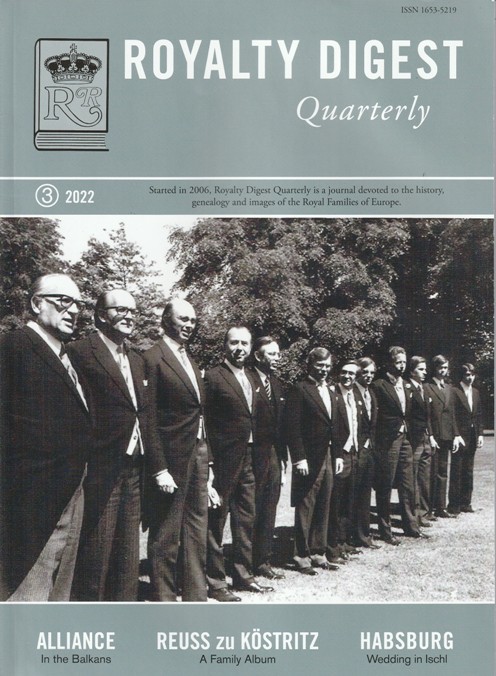
The front cover this time shows a photo of 12 princes of the Reuss. The main article in this issue is called Die Fürsten Reuss zu Köstritz – A Family Album and is written by the  magazine's editor, Ted Rosvall. He writes that «The Reuss zu Köstritz family is huge and extremely difficult to keep track of – not least because of the many inter-marriages between and within the various branches – and it is also very  difficult to find images of the various members. I have therefore chosen to focus on the more easily accessible branches and family members, describing this article as more of a collage than an album.» No reason to be so modest, I think Rosvall has done a good job in presenting the house and finding images. All in all I count 87 images of various family members and palaces. Rosvall gives an introduction to the dynasty and also presents 4 family tables. There is even a photo of Prince Heinrich XIII Reuss, b. 1951, who was arrested in December this year for allegedly having a leading role in the so-called coup d'état plot. A distant cousin, Prince Heinrich XIV Reuss, b. 1955, is today the head of the house. In an interview with BBC News, he said that «This outsider was ostracised years ago because of his outlandish conspiracy theories and antisemitic views. He's not representative of our family at all.» Rosvall might mention the black sheep in a future issue.

In his Editor's Corner, Rosvall of course writes about Queen Elizabeth II, who died on 8 September 2022, 96 years old. Rosvall writes among others: «Elizabeth II will go down in history as a straight-back and dutiful head of state who, against all odds, managed to hold together not only one nation but a large group of other countries within the Commonwealth.» He continues: «The Queen was also the epicenter  of constitutional monarchy, a form of government that has proven superior to most others. A counterweight to all the wretched dictators and tyrants currently plaguing our world, elected or not.»

The contents of the third issue this year:
  • Marlene A. Eilers Koenig: A Maritial Alliance. The Marriage of King Alexander of Yugoslavia and Princess Marie of Romania, pp. 1–12.
  • Stephen Bunford: The Murdering Prince, pp. 13–16.
  • Alexandre Tissot Demidoff & Richard Jay Hutto: The Karageorgevitch Twins. Princes or not ..., pp. 17–26.
  • Elizabeth Jane Timms: A Wedding in Ischl, pp. 27–34.
  • Ted Rosvall: Die Fürsten Reuss zu Köstritz - A Family Album, pp. 35–56.
  • Ove Mogensen: Tombs, Graves and Monuments in Thuringia. VII: Reuss zu Greiz (Ältere Linie), pp. 57–59.
  • Coryne Hall: Little-known Royals. Prince Georg of Denmark, pp. 60–61.
The issue also includes two book reviews – Michael L. Nash gives his view on Defenders of the faith. British Monarchy, Religion and the Next Coronation by Catherine Pepinster (Hodder & Stoughton, 2022), while the editor himself has written a review of Queen Victoria in Cornwall by Susan Symons (of German castles and palaces fame) (2022).

The World Wide Web of Royalty column this times gives us genealogical news from or about Bavaria, Belgium, Brazil, England (United Kingdom or at least Great Britain, it should have been), Hochberg/Pless, Mecklenburg and Württemberg.

If anyone wonders, the murdering prince in question was Prince Pierre Napoléon Bonaparte (1815–1881), the sixth child of Lucien Bonaparte, who was a younger brother of Emperor Napoléon. The wedding that took place in Ischl in 1890 was between Archduchess Marie Valerie of Austria (1868–1924), fourth child of Emperor Franz Joseph (1830–1848–1916), and Archduke Franz Salvator of Austria (1866–1939), son of Archduke Karl Salvator of Austria and Princess Maria Immacolata of Bourbon-Two Sicilies. The so-called Karageorgevich twins – Nicholas and Sergei – were born into the marriage of Prince Arsene Karageorgevich (1859–1938) and Princess Aurora Demidoff (1873–1904), but was the product of an affair Aurora had with Count Ernst Andreas von Manteuffel (1873–1953). 

All in all several articles worth reading this time as well. If you are not subscriber yet, information about Royalty Digest Quarterly can be found at its editor's website Royalbooks.se. See earlier presentations of RDQ here. See also its Facebook page.

11 July 2022

Royalty Digest Quarterly no. 2, 2022

RDQ goes to Monaco! The front page of Royalty Digest Quarterly no, 2, 2022 tells it all. This issue's Family Album covers the princely family of Monaco, presented by Stephen Bunford and Ted Rosvall. In addition to the 3 pages long introduction the readers can enjoy 48 illustrations and one page containing a family table starting with Antoine I (1661–1731) and ending with the twins Gabriella and Jacques. 

From the contents:

  • Stephen Bunford: The loves of Ludwig I and Ludwig II of Bavaria, pp. 1–8
  • Elizabeth Jane Timms: Imperial Visit to Vienna, pp. 9–17.
  • Stephen Bunford/Ted Rosvall: The Grimaldis of Monaco – A Family Album, pp. 18–32.
  • Marlene A. Eilers-Koenig: The Air Princess. Lady Anne Saville, Princess of Löwenstein-Wertheim-Freudenberg, pp. 33–41.
  • David Horbury: Royalty and Romance at the Greek Court. From the Letters and Memoirs of John Boxshall, pp. 42–48.
  • Datiu F. Salvia Ocaña: King Alfonso XII's European Journey in 1883, pp. 49–55.
  • Coryne Hall: Little-Known Royals. Grand Duchess Alexandra Nicolaievna of Russia, pp. 56–57.
  • Ove Mogensen: Tombs, Graves and Monuments in Thuringia. VII. Reuss-Schleiz (Jüngere Linie), pp. 58–60.
  • Ted Rosvall: Discarded "Wrangels", pp. 62–63.
  • The World Wide Web of Royalty, p. 64.
The latter column contains genealogical news from the royal or princely families of Austria-Tuscany, Hesse, Reuss, Saxony, Waldeck and Pyrmont, Württemberg and Sayn-Wittgenstein-Berleburg.

Several interesting pieces this time as well. My favourites were The Air Princess and the Boxshall article. Not very often you read about the Löwenstein-Wertheim-Freudenbergs, even if this article is mainly about Anne (1864–1927), daugher of John Saville, 4th Earl of Mexborough. John Boxshall (1923–2008) was the grandchild of Prince Barbu Stirbey (1872–1946), once prime minister of Romania and perhaps most well-known for his relationship with Queen Marie of Romania. John's experiences at the Greek Court while residing in Athens were very interesting. Would love to read more about the Stirbeys!

Information about Royalty Digest Quarterly can be found at its editor's website Royalbooks.se. See earlier presentations of RDQ here. See also its Facebook page.

27 April 2022

Royalty Digest Quarterly no. 1, 2022

I received my copy of the lastest issue of Royalty Digest Quarterly – no. 1, 2022 – about a month ago. I have been involved in several genealogy projects since then, so my blog was put on hold for a while. I am almost always involved in various genealogy projects, so I guess it is a bad excuse, but I am enjoying my genealogy research so much ...

Anyway ... The editor Ted Rosvall usually stays away from politics in his Editor's Corner, but this time he has made an exception. He has chosen to comment on the ongoing war in Ukraine and ends by writing: «Royalty Digest Quarterly stands behind the Ukrainian people and their brave leaders in their struggle for a free and independent Ukraine». So do I! Most members of «the European Royal Family» have shown sympathy with Ukraine in various ways since the Russian invasion in February. It cannot have been easy for Grand Duchess Maria of Russia, whose family ruled the Russian Empire, which included what is nbow the Russian Federation and Ukraine, for several hundred years, but I think she made her views on the war clear in her statement of 24 February

There are two church-related articles in this issue. Edward W. Hanson shows in his article Royal Priests, Monks and Nuns that quite a few royals, especially members of Catholic families, have taken holy vows throughout the years. The author Edward Hanson is an historian as well as a priest in the Church of England, so I can well understand that he is interested in this topic. Jonathan Iglesias Sancho and Blanca Briones Conzáles on the other hand has written an interesting piece on the relationship between the Romanovs and the Vatican.

The front page gives an illustration of King Gustaf V and Queen Victoria of Sweden, which means that the first issue of 2022 contains the second part of The Bernadottes of Sweden - A Family Album, written by the editor himself. The number of illustrations – 133 in all, if I have managed to count correctly  must be a new record in this series of family albums. In addition there is one page with a genealogical table showing the descendants of King Gustaf V.

Next one out is Michael L. Nash' enjoyable article "Collecting all the Sunshine .....". The First Modern Royal Family, which describes the wedding between Princess Mary (the Princess Royal) and Henry Lascelles (then Viscount Lascelles, later the 6th Earl of Harewood, in 1922.

Then Eric Lowe continues his series Elegant Royals – Some favorites from my collection, before Ove Mogensens tells the story of Schwarzburg-Rudolstadt in his article series Tombs, Graves and Monuments in Thuringia (part. VI).

Prince Eugen of Sweden (1865–1947) was a well-known artist in Scandinavia and also a well-liked member of the royal family. But perhaps not so well-known outside Sweden, Norway and perhaps also Denmark. He is the topic of Coryne Hall's Little-Known Royals. I really enjoyed my visit to Prince Eugen's Waldemarsudde in Sweden when I visited it back in 2006. I can really recommend it.


Prince Eugen's house and grave at Waldemarsudde. © 2006 Dag Trygsland Hoelseth.

The World Wide Web of Royalty this time brings news of the Imperial, Royal or Princely houses of Austria, Austria-Este, Luxembourg, Prussia, and Bourbon-Two Sicilies.

Information about Royalty Digest Quarterly can be found at its editor's website Royalbooks.se. See earlier presentations of RDQ here. See also its Facebook page.

12 February 2022

Royalty Digest Quarterly no. 4, 2021

I received the latest issue of Royalty Digest Quarterly – no. 4, 2021 – about a month ago, so obviously it is on time to write a few words. The red color of the front cover seems darker in print than in the photo published at the RDQ Facebook group. The image is of the Swedish Royal Family in 1905, showing (standing) Prince Eugén, Prince Oscar and Princess Ebba Bernadotte, Prince Wilhelm, Princess Margaretha, Prince Gustaf (VI) Adolf,  Crown Princess Victoria, Prince Erik, Crown Prince Gustaf (V) and Prince Carl and in front (sitting) Princess Therese,  Queen Sophie, King Oscar II and Princess Ingeborg with her daughters Princess Märtha and Princess Margaretha. The front cover image tells the readers that Sweden is the topic of the traditional Family Album, this time written by the editor Ted Rosvall himself instead of the magazine's historical consultant Charlottge Zeepvat. As always the readers are treated with a short introduction in addition to a large selection of images of royals and palaces as well as genealogical tables. Rosvall has already mentioned a few mistakes in the genealogical table on page 33. It is a bit ironic that such (minor) mistakes have been made by the world's Bernadotte genealogy expert no. 1, but as they say, it can happen to the best of us!

In his Editor's Corner Ted Rosvall gives a warm thank you note to alle the contributions Charlotte Zeepvat has made to the magazine both as an editorial consultant and as a writer of numerous articles. The way the column is worded one starts to wonder whether this means that Zeepvat has stepped down as historical consultant, but I can't find any explicit mentioning of this.

Datiu Salvia Ocaña has this tine written an interesting piece titled The Demidoffs and the Royals. The Russian noble family has interesting connections to the imperial and royal houses of France-Bonaparte and Serbia-Karadjordjevic. I learn a lot from this article, but there are quite a lot of names, so I wonder if the article would be easier to read with the help of a genealogical survey.

Another interesting article in this issue is The Very Short Reign of Boris I, which gives the story of Boris Skosyrev, who in 1934 proclaimed himself King of Andorra! The author is Michael Nash, who has made numerous contributions to RDQ before.

Charlotte Zeepvat then returns with A Long Chain of Persecutions. Princess Luise Sophie of Schleswig-Holstein and Prince Friedrich Leopold of Prussia. Part 2: The Children's Story. I commented on the first part in January. As I wrote then, the couple in question is Princess Luise Sophie (1866–1952), the sixth child of Duke Friedrich of Schleswig-Holstein-Sonderburg-Augustenburg (1829–1880), by his wife Princess Adelheid of Hohenlohe-Langenburg (1835–1900). Luise Sophie married in 1889 Prince Friedrich Leopold of Prussia (1865–1931). One of Princess Luise Sophie's brothers-in-law was Emperor Wilhelm II, who caused so much misery in the family. Luise Sophie and Friedrich Leopold had four children –Viktoria Margarete «Agra»  (1890–1923, who married (and later divorced) Prince Heinrich XXXIII Reuss (1879–1942), Friedrich Sigismund (1891-1927),who married Princess Marie Luise of Schaumburg-Lippe (1897–1938), Friedrich Karl (1893–1917) and Friedrich Leopold (1895–1959). Viktoria Margarete and Friedrich Sigismund gave Luise Sophie and Friedrich Leopold four grandchildren. I guess there were great-grandchildren as well, but it might take some time to figure out the number. Many tragedies in this family. And the article is so well written and researched.

Eric Lowe has contributed with the article Elegant Royals  Some favorites from my collection. Lowe has a large collection of photos of royalty and is also a photographer himself. He is also the administrator of the Facebook group Elegant Royals, which has more than 2700 members.

The series Little-Known Royals is continued in this issue as well, and Coryne Hall has this time written about Princess Josephine Caroline of Belgium (18721952), who married Prince Karl Anton of Hohenzollern(-Sigmaringen) (18681919) in 1894. There were four children in this marriage and many grandchildren. There is an interesting article (no date given) about this family in Deutsches Adelsblatt titled Ein Konzert rettet die Burg.

The column The World Wide Web of Royalty this time gives us genealogical news about the non-royal part of the Bernadotte family, Bourbon-Parma, Hohenlohe-Langenburg, Russia, Schaumburg-Lippe and Schleswig-Holstein (Glücksburg).

Information about Royalty Digest Quarterly can be found at its editor's website Royalbooks.se. See earlier presentations of RDQ here. See also its Facebook page.

5 January 2022

Royalty Digest Quarterly no. 3, 2021

I received the third issue of Royalty Digest Quarterly ages ago, and as the fourth issue is just around the corner, I thought it was on time to write a few words. I have several periodicals in line to be commented on, so stay tuned for the next few weeks ...

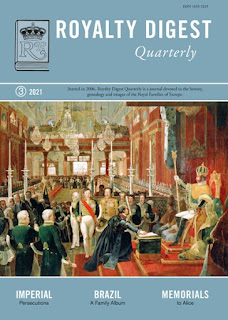
My first impression: What a beautiful cover! Both the greyish-blue cover and the photo – of the coronation of Emperor Dom Pedro I of Brazil on 1 December 1822 in the Old Cathedral of Rio de Janeiro – look great. The photo is followed up by Charlotte Zeepvat's article  The Imperial House of Brazil  A Family Album. Besides the introduction to the Brazilian imperial family the readers can enjoy nearly 100 illustrations of various family members and residences. There are many reasons why I would like to visit Brazil one day – the imperial summer palace at Petrópolis is one of them – it just looks splendid! In addition to the illustrations there are also four pages of genealogical tables.

Charlotte Zeepvat's second contribition is the article A Long Chain of Persecutions. Princess Luise Sophie of Schleswig-Holstein and Prince Friedrich Leopold of Prussia. Part I: A Divided Family. The couple in question is Princess Luise Sophie (1866–1952), the sixth child of Duke Friedrich of Schleswig-Holstein-Sonderburg-Augustenburg (1829–1880), by his wife Princess Adelheid of Hohenlohe-Langenburg (1835–1900). Luise Sophie married in 1889 Prince Friedrich Leopold of Prussia (1865–1931). Her elder sister Auguste Viktoria (1858–1921) was the first wife of Emperor Wilhelm II (1859–1941), and who caused the long chain of persecutions. It is almost unbelieveble how badly treated the princess and her husband were. I look forward to reading the second part.

Other articles:

  • Memorials to Princess Alice, Grand Duchess of Hesse by Elizabeth Jane Timms
  • A Devoted Servant – Albert Latapie by Alberto Penna Rodrigues
  • Tombs, Graves and Monuments in Thurungia. V: Schwarzburg-Sondershausen by Ove Mogensen
  • Little-Known Royals. Prince Peter of Greece by Coryne Hall
  • The World Wide Web of Royalty. Births, marriages, deaths and other events in the Royal Families of Europe
The latter column includes news from Austria, Bentheim-Steinfurt, Liechtenstein. Schaumburg-Lippe and Bourbon-Two Sicilies. The aforementioned Albert Latapie (b. 1877) was employed by Princess Isabel of Brazil and her husband Count d'Eu and their children. The article contains extracts of his memoirs.

All in all the issue had several most readable articles and fortunately I don't have to wait long for the fourth and last issue of 2021 to arrive.

Information about Royalty Digest Quarterly can be found at its editor's website Royalbooks.se. See earlier presentations of RDQ here. See also its Facebook page.

25 August 2021

Royalty Digest Quarterly no. 2, 2021

I received my copy of Royalty Digest Quarterly no. 2, 2021 back in July, but I left on vacation just after and then I was occupied with work and therefore have not had the time to write a few lines before now. 

Prince Philip, Duke of Edinburgh, who died on 9 april this year, turns up in several articles in the present issue. In Ted Rosvall's Editor's Corner Philip's death is mentioned, before the editor moves on to the topic of royal centenarians. As you well know Prince Philip died just two months before he would have reached the grand age of 100, but Rosvall gives examples of other royals who did. Born royals, that is.

Then Marlene A. Eilers Koenig follows up with the article Four Sisters, Four Weddings, and yes, it is Prince Philip's sisters Margarita (1905–1981), Theodora (1906–1969), Princess Cecilé (1911–1937) and Sophie (1914–2001) she is focusing on. And of course, towards the end of the magazine, Prince Philip's death is listed in the column The World Wide Web of Royalty. Births, marriages, deaths and other events in the Royal Families of Europe. The column also covers the birth of Lilibet Diana Mountbatten-Windsor as well as news from Greece, Italy, Sweden and Württemberg.

The cover photo is from the silver wedding of Prince Heinrich XXVII Reuss j.L. (Reuss-Schleiz) (1858–1928) and his wife Elise (1864–1929) at Schloss Osterstein in Gera in 1909. This means that The House Reuss zu Schleiz (Younger Line) is the chosen topic for this issue's Family Album. This time, however, is the introduction not written by Charlotte Zeepvat as usual, but by the editor himself, Ted Rosvall, with contributions from Bearn Bilker. The album contains 50 illustrations this time (of various members as well as of  palaces besides a map, the coat of arms and various coins) and one page with genealogical tables.

Those who are interested in articles about royal graves will be delighted to know that Lucas Szkopinski has made the contribution The Bourbon Crypt at the Kostanjevica Monastery (Nova Gorica), while Ove Mogensen has returned with part IV of Tombs, Graves and Monuments in Thuringia, which deals with Saxe-Coburg and Gotha this time.

It is not very often that the magazine contains articles about non-European topics, but I appreciate it when it does. This time Stephen Bunford treats us with the article Our Hawaiian Friends. Royal connections between Britain and Hawaii. As the title suggests, it is a combination article, where Queen Victoria (1819–1901) is the main figure on the British side.

The historian and author Trond Norén Isaksen has written an insightful article titled Henri from Navarre. Prince Henrik of Denmark and the Kings Consort of Navarre. He has touched upon the subject of kings consort also earlier, and wrote a debate article on the subject in Aftenposten 10 August 2021.

If this was not enough, there are three more articles in the magazine! Charlotte Zeepvat was not behind the family album this time, but she has made great contribution with her article 'Tante Mossy'. Quen of Finland, which is about Landgravine Margarethe of Hesse-Kassel (1872–1954), née Princess of Prussia and a sister of Emperor Wilhelm II. The article title is formally correct, as Margarethe's husband, then Prince Friedrich Karl (1868–1940) was elected King of Finland by a rump parliament in 1918, but still somewhat misleading, as Friedrich Karl never accepted the offer, as he could predict the outcome of the war and that his relationship to Emperor Wilhelm would be a problem for the great powers. Friedrich Karl never set foot in Finland, but his son Wolfgang (1896-1989) did during WW2.

Not mentioned in the index, but there is a book review this time, written by Ted Rosvall. He comments on the sixth volume of Susan Symons' series of German castles and palaces, titled Schloss in Thuringia. I only own the three first volumes, so obviously I have get hold of the newer ones.

Little-known Royals? Coryne Hall this time presents Prince Nicholas of Romania (1903–1978), the fourth child of King Ferdinand of Romania (1865–1927) and his wife Queen Marie (1875–1938), née Princess of the United Kingdom of Great Britain and Ireland (and Princess of Saxe-Coburg and Gotha from 1893). Yes, I agree, Prince Nicholas certainly belongs to the group of little-known royals. 

Information about Royalty Digest Quarterly can be found at its editor's website Royalbooks.se. See earlier presentations of RDQ here. See also its Facebook page.