Showing posts with label Romania. Show all posts

30 January 2024

Royalty Digest Quarterly no. 3, 2023


The third issue of Royalty Digest Quarterly in 2023 was published some time last fall and should of course have been commented on a long time ago. There are two reasons for this lag – the first is that I focused so much on various genealogy projects last fall that I didn't blog much at all. The other is that I misplaced my copy of RDQ before I got the chance to read it. It was rediscovered in a bag I normally don't use around Christmas time. And so far this month I have written so much about the events in Denmark besides commenting on other periodicals. I now realize that I haven't commented on issue no. 2 from last year either. No, I haven't lost that copy, but I think the train has passed for commenting on it. Anyway, no. 3 has been read and it's on time to write a few words. 

Contents:
  • Marlene A. Eilers Koenig: The Wedding of Gusty and Louise, pp. 1–10.
  • Ted Rosvall: The Landgraves of Hessen-Homburg, pp. 11–20.
  • Susan Symons: The Princesses of Hessen-Homburg, pp. 23–30.
  • Elizabeth Jane Timms: Imperial Governess. Miss Throckmorton and Marie Valerie, pp. 31–41.
  • Ove Mogensen: Tombs, Grave and Monuments in Romania, pp. 42–48.
  • Ted Rosvall: A Double Jubilee in Sweden, pp. 49–55.
  • Ted Rosvall: Royal Bustards, p. 56.
  • Stephen Bunford: George III's illegitimate grandchildren, pp. 57–61.
  • Coryne Hall: Little-Known ROYALS. Princess Zorka of Montenegro, pp. 62–63.
  • The World Wide Web of Royalty, p. 64.
In other words plenty of articles worth reading. First one out is Marlene Koenig's article on the wedding of the then Crown Prince Gustaf Adolf of Sweden to Lady Louise Mountbatten in 1923. Crown Prince Gustaf Adolf, eldest son of King Gustaf V and Queen Victoria, née Princess of Baden, had earlier been married to Princess Margaret of the United Kingdom of Great Britain and Ireland, who died in 1920, only 38 years old. Margaret was the eldest daughter of the Duke of Connaught and the Duchess of Connaught, nee Princess Luise Margarete of Prussia. Lady Louise Mountbatten was born in 1889 as Princess of Battenberg, the second daughter of Prince Louise of Battenberg and Princess Victoria of Battenberg, née Princess of Hesse and by Rhine. As is well known, Prince Louis relinquished his his title Prince of Battenberg and style of Serene Highness in July 1917 and anglicised his family name to Mountbatten. In November 1917 Louis was created Marquess of Milford Haven. His eldest daughter Alice, mother of Prince Philip, was already married at the time, so only the three younger children stopped using their princely titles and assumed courtesy titles as children of a British Marquess. I make a point of this because it meant that Louise was not a princess in 1923, and the Swedish Act of Succession at the time said that a a Prince would lose his rights if he married «a private man's daughter», i.e. was not a royal or equal. Lady Louise would thus come into this category, but the matter was «solved» when the British prime minister at the time confirmed that she was a member of the British Royal Family and was included in the list of precedence at the court. Obviously the understanding ot the article in the Act of Succession was stretched a bit for the marriage to go ahead without consequences. But married they were, and upon Gustaf Adolf's succession in 1950 as King Gustaf VI Adolf, Crown Prince Louise became Queen of Sweden. She died in 1965, 75 years old.

Ted Rosvall then tells the story of the Landgraves of Hesse-Homburg (or Hesse-Homburg if you like), perhaps one of the less known houses of Hesse. The last Landgrave of Hesse-Homburg was Ferdinand (1783–1866), second youngest son of Landgrave Friedrich V (1748–1820) and Landgravine Karoline, née Princess of Hesse-Darmstadt (1746–1821). His elder brothers Friedrich, Ludwig, Philipp and Gustav had also been Landgraves, but none of them left a male heir to carry on the line. Besides the short presentation the article includes 35 illustrations of family members, palaces/castles and even a map.Thankfully Rosvall has also provided a «select family tree», which is useful when reading Susan Symon's article The Princesses of Hessen-Homburg. The said princesses were the five sisters of the above-mentioned landgraves who survived childhood. All in all Friedrich V and Karoline had 15 children (An Online Gotha lists 13 of them). Symons, whos known for her book series about German palaces and castles, gives a good outline of the princesses and their marriages and offspring.

Elizabeth Jane Timms's article Imperial Governess. Miss Throckmorton and Marie Valarie is based on among others the Throckmorton papers (correspondence etc.) kept in the Warwickshire County Record Office and the court archives in Vienna. Miss Mary Throckmorton (1832–1919) was a daughter of Sir Robert George Throckmorton, 8th Baronet and his wife, Elizabeth Acton, daughter of Sir John Francis Edward Acton, Baronet of Aldenham. Miss Throckmorton served as Governess to Archduchess Marie Valerie (1868–1924), youngest child of Emperor Franz Joseph (1830–1916) and Empress Elisabeth, née Duchess in Bavaria (1837–1898), from 1869 to 1874. In this first (of two) articles on the Imperial Governess we follow the lives of Marie Valerie and her former governess through the correspondence they kept. As I have written on so many occasions, I love these articles where you read about royalty through people who were employed at a court. The article is well written and well researched. And thankfully, as already mentioned, there is a second article on the relationship between the Archduchess and her former governess.

Ove Mogensen has traveled all over the world to visit and take photographs of tombs, graves and monuments of the many royal and princely houses and have written numerousn articles about these visits in RDQ. This time we learn about the graves of various members of the Romanian royal family in and outside Romania. This sort of articles is another – and good – way to learn more about royal history. And as always well illustrated

The editor of Royalty Digest Quarterly, Ted Rosvall, has contributed to several articles in this issue. In A Double Jubilee in Sweden, we learn both about the 500th anniversary of Gustav Vasa's succession to the Swedish throne and Carl XVI Gustaf's 50th anniversary as King of Sweden. The author also gives us a short presentation of the monarchs between 1523 and 2003. In his Royal Bustards series, Rosvall then tells the story of the Swedish singer Carl-Erik Olivebring (1919–2002), who might have been the illegitimate son of King Gustaf VI Adolf (also mentioned above). Her mother was a lady-in-waiting at the Royal Court in Stockholm, Judith Cecilia Serafia Andersson (1877–1924). The official records say that his father was a farmer named Lars Ersson, b. 1844. Other than the connection to the court, there is nothing that backs up the claim, other than that the singer had an «uncanny resemblance to some of the king's sons, especially Prince Sigvard and Prince Bertil». Oh well. 

Stephen Bunford follows up with a good discussion about and outline of King George III of Great Britain and Ireland's illegitimate grandchildren.

I have earlier questioned some of che choices for the series Little-Known ROYALS written by Coryne Hall, but of course it will depend how much knowledge you have about the present and former monarchies. Princess Zorka of Montenegro (1865–1890) was the eldest daughter and child of Prince Nikola, later King Nikola of Montenegro (1841–1860–1921) and Princess, latger Queen, Milena, née Vukotic (1847–1923). She married Prince Peter Karadjordjevic (1844–1921), who became King of Serbia in 1903, but by then Zorka had been dead for 13 years. I am not sure if she had been better known if she had lived longer and become Queen. One could say that the kingdom of Serbia is better known than the smaller neighbour kingdom of  Montenegro, but again it all depends on your knowledge. I think she fits the category, and anyway, Coryne Hall tells her story well.

The genealogical news included in the The World Wide Web of Royalty column are from events in July, August and September 2023, so they are a bit old now, but such records of events can be useful nevertheless. This time the readers are given news from the Imperial, royal and princely houses of Austria, Bavaria, Bourbon-Parme, Denmark (Rosenborg), France-Orléans, Schleswig-Holstgein and Württemberg.

If you are not already a subscriber to Royalty Digest Quarterly, please consider it! Information about the magazine can be found at its editor's website Royalbooks.se. See earlier presentations of RDQ here. See also its Facebook page.

28 December 2022

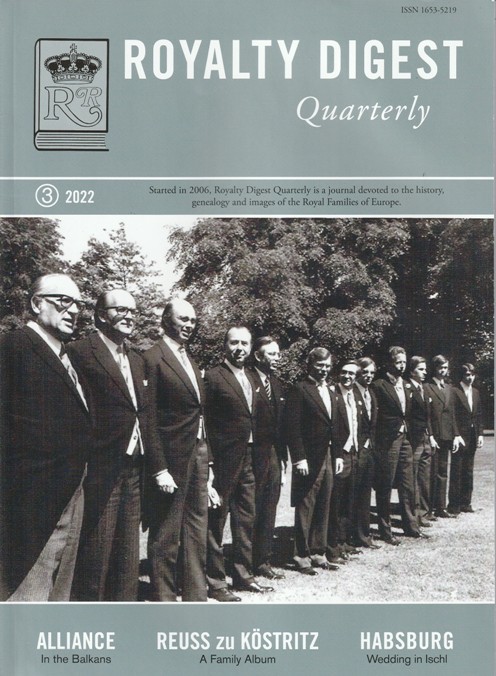
Royalty Digest Quarterly no. 3, 2022

I received my copy of Royalty Digest Quarterly no. 3, 2022 on 5 October 2022, but haven't had much time for blog activities since then. Some periods of the year are just more hectic than others. I have already received issue no. 4, so I better write a few words about no. 3 before I start reading the next issue. 

The front cover this time shows a photo of 12 princes of the Reuss. The main article in this issue is called Die Fürsten Reuss zu Köstritz – A Family Album and is written by the  magazine's editor, Ted Rosvall. He writes that «The Reuss zu Köstritz family is huge and extremely difficult to keep track of – not least because of the many inter-marriages between and within the various branches – and it is also very  difficult to find images of the various members. I have therefore chosen to focus on the more easily accessible branches and family members, describing this article as more of a collage than an album.» No reason to be so modest, I think Rosvall has done a good job in presenting the house and finding images. All in all I count 87 images of various family members and palaces. Rosvall gives an introduction to the dynasty and also presents 4 family tables. There is even a photo of Prince Heinrich XIII Reuss, b. 1951, who was arrested in December this year for allegedly having a leading role in the so-called coup d'état plot. A distant cousin, Prince Heinrich XIV Reuss, b. 1955, is today the head of the house. In an interview with BBC News, he said that «This outsider was ostracised years ago because of his outlandish conspiracy theories and antisemitic views. He's not representative of our family at all.» Rosvall might mention the black sheep in a future issue.

In his Editor's Corner, Rosvall of course writes about Queen Elizabeth II, who died on 8 September 2022, 96 years old. Rosvall writes among others: «Elizabeth II will go down in history as a straight-back and dutiful head of state who, against all odds, managed to hold together not only one nation but a large group of other countries within the Commonwealth.» He continues: «The Queen was also the epicenter  of constitutional monarchy, a form of government that has proven superior to most others. A counterweight to all the wretched dictators and tyrants currently plaguing our world, elected or not.»

The contents of the third issue this year:
  • Marlene A. Eilers Koenig: A Maritial Alliance. The Marriage of King Alexander of Yugoslavia and Princess Marie of Romania, pp. 1–12.
  • Stephen Bunford: The Murdering Prince, pp. 13–16.
  • Alexandre Tissot Demidoff & Richard Jay Hutto: The Karageorgevitch Twins. Princes or not ..., pp. 17–26.
  • Elizabeth Jane Timms: A Wedding in Ischl, pp. 27–34.
  • Ted Rosvall: Die Fürsten Reuss zu Köstritz - A Family Album, pp. 35–56.
  • Ove Mogensen: Tombs, Graves and Monuments in Thuringia. VII: Reuss zu Greiz (Ältere Linie), pp. 57–59.
  • Coryne Hall: Little-known Royals. Prince Georg of Denmark, pp. 60–61.
The issue also includes two book reviews – Michael L. Nash gives his view on Defenders of the faith. British Monarchy, Religion and the Next Coronation by Catherine Pepinster (Hodder & Stoughton, 2022), while the editor himself has written a review of Queen Victoria in Cornwall by Susan Symons (of German castles and palaces fame) (2022).

The World Wide Web of Royalty column this times gives us genealogical news from or about Bavaria, Belgium, Brazil, England (United Kingdom or at least Great Britain, it should have been), Hochberg/Pless, Mecklenburg and Württemberg.

If anyone wonders, the murdering prince in question was Prince Pierre Napoléon Bonaparte (1815–1881), the sixth child of Lucien Bonaparte, who was a younger brother of Emperor Napoléon. The wedding that took place in Ischl in 1890 was between Archduchess Marie Valerie of Austria (1868–1924), fourth child of Emperor Franz Joseph (1830–1848–1916), and Archduke Franz Salvator of Austria (1866–1939), son of Archduke Karl Salvator of Austria and Princess Maria Immacolata of Bourbon-Two Sicilies. The so-called Karageorgevich twins – Nicholas and Sergei – were born into the marriage of Prince Arsene Karageorgevich (1859–1938) and Princess Aurora Demidoff (1873–1904), but was the product of an affair Aurora had with Count Ernst Andreas von Manteuffel (1873–1953). 

All in all several articles worth reading this time as well. If you are not subscriber yet, information about Royalty Digest Quarterly can be found at its editor's website Royalbooks.se. See earlier presentations of RDQ here. See also its Facebook page.

19 October 2016

Royalty Digest Quarterly no. 3, 2016

In his Editor's Corner in the latest issue of Royalty Digest Quarterly (no. 3, 2016), Ted Rosvall comments on the increasing number of divorces within the European Royal Families. The lastest out is the separation of Princess Märthan Louise of Norway and Ari Behn, announced by the Norwegian Royal Court in August 2016. In the 19th century royal divorces were «extremely scarce», as Rosvall points out. He has made a list of the examples he could think of, 12 in all.

On the front page the readers are served a photo of Queen Victoria in the mid-1960s surrounded by (from the left) the Crown Princess of Prussia, Princess Beatrice, Prince Leopold and Princess Louise.

The opening article, Mariana Vitoria and the Royal weddings in Portugal in the 18th Century, is written by Alberto Penna Rodrigues. Portuguese royalty is a topic he knows well, and it is a well-written, very detailed  and interesting article, even if it could have been somewhat better organised. The Mariana Vitoria (Maria Anna Victoria) (1718–178) in question was the eldest daughter of King Felipe V of Spain and Isabel Farnesio. She was first engaged to King Louis XV of France at the age of seven (!) and later married to the future King João V of Portugal.

I have earlier several times written how much I like to read articles about «royal surroundings» and not only the royals themselves: Nannys, court members, private teachers (tutors) etc. Another way of learning more about the royals and the royal court in question. The second part of Charlotte Zeepvat's article 'My dearest Patsy'. A nurse and her royal patients was as interesting as the first part. The nurse  Elizabeth Paterson, née Stuart gave a helping hand in connection with many royal births, and we learn a lot about both her and the royals in question through an impressive amount of letters.

The readers are also treated with the third part of Charlotte Zeepvat's The Royal House of Great Britain and Ireland. A Family Album. Besides the introduction, the article includes 106 portraits/family group photos besides a photo of Balmoral. Queen Victoria even smiles on one of the photos! The two pages mapping out the descendants of james VI of Scotland and I of England are most useful.

Queen Anne of Romania, née Princess of Bourbon-Parme, died on 1 August 2016, and the historian Diana Mandache has written her obituary. Romania is also the topic in the article Half a Century of Royal Letters; 1899-1946. Collected by John Wimbles from the Romanian National Archives and other sources, compiled and introduced by David Horbury. So many wonderful letters! I just loved it. Give us more!

Finally, the latest issue gives us royal news through the column The World Wide Web of Royalty. This time we get news from the Imperial, Royal and/or Princely (or ducal) families of Denmark, Hohenlohe, Leiningen, Romania, Sweden and Westminster. The death of Gunnila Bernadotte, Countess of Wisborg, is included. The short note says she had three children with her first husband, while she had in fact four, but this was not well known outside family circles when the magazine went to print.

Information on Royalty Digest Quarterly can be found at its editor's website Royalbooks.se. See earlier presentation of RDQ here. See also its Facebook page.

12 August 2016

Romanian Royal Family Links

The task of transferring the old pages from my old Geocities.com website to Hoelseth.com has obviously taken longer than I had expected. The main reason is, as I have also commented on earlier, that family life and work have to come first, and in the last few years I have also preferred to spend more time on working for the Norwegian Genealogical Society, genealogical research, blog writing as well as working for Slektshistoriewiki, the Norwegian Genealogy Wiki. I am one of the administrators for the wiki and I also contribute with articles and illustrations.

It is not that challenging work to transfer old pages from my old to my «new» website, but some structure changing and coding has to be done, as well as link renovation, and it is kind of boring. But I am happy whenever I get something done!

Yesterday evening I finally got the Romanian Royal Family Links page with its subpages up and going again. The reason for doing it now is of course that the former King Michael's wife, Queen Anne, née Princess of Bourbon-Parma, died in Switzerland on 1 August 2016. The burial will take place in Romania on 13 August.

In connection with the updating many «dead» links had to be deleted. One can always discuss if there still is a need for such index pages like the Romanian Royal Family Links page, but as it still has some links to material which is not so easy to find, I have decided to let it stay. Some of the material is from the time when information, especially constitutional details, about the monarchy was not available to the same extent as today. I still have constitutional texts in my paper archives which have to be added. So one of these days...

If you have recommendations for other websites about the Romanian royal family which you think I should include, please tell!

23 May 2016

Romania-insider.com: Romania’s Royal Family wants tax exemption for their Savarsin Castle

The English-speaking Internet news service Romania-insider.com published an interesting article about the Romanian royal family on 19 May 2016:

Romania’s Royal Family wants tax exemption for their Savarsin Castle

Certainly it is the king's legal right to ask for tax excemption for his property in Savarsin, but if it is really the wisest thing to do, is another.

Blogglistenhits

17 August 2013

Princess Irina of Romania arrested

It is not often you hear about Princess Irina of Romania, the third daughter of the former King Michael of Romania. But this morning I woke up to the news that she and her husband, John Wesley Walker, had been arrested in her home state of Oregon, USA, accused of having staged cockfighting derbies!

The Press Office of King Michael has released the following declaration:
His Majesty King Michael I has noted with deep sorrow the events related to Princess Irina of Romania, his daughter. His Majesty and the Royal Family as a whole hope that the justice system of the US and the courts of the Oregon state will offer an as equitable and rapid solution as would be possible in this case.

His Majesty also hopes that the presumption of innocence to function, as is normal legally and morally, from the onset to the end of this unfortunate event.
The translation has kindly been provided by Valentin Mandache. His wife Diana has used the same translation at her blog. Diana Mandache has also provided comments made by Princess Irina's daughter Angelica Kreuger in her blog, which is worth reading.

Princess Irina, who was born at Lausanne, Switzerland on 28 February 1953, is the third daughter of the former King Michael (Mihai) of Romania and his wife Anne, née Princess of Bourbon-Parma. She married John Kreuger in 1983 and had two children by him, Michael, b. 1985, and the aforementioned Angelica, b. 1986. After their divorce, Irina married John Wesley Walker in 2007.

Updated on 17 August 2013 at 01:10 (original link to Oregonlive.com replaced with Usatoday.com, as the former seemws to have a virus of some sort, as confirmed by McAfee).

14 October 2009

Citation for the Legion of Merit. Degree of Chief Commander


The White House, Washington

Citation for the Legion of Merit. Degree of Chief Commander

His Majesty King Mihai I of Rumania rendered exceptionally meritorious conduct in the performance of outstanding service to the cause of the Allied Nations in their struggle against Hitlerite Germany. In July and August, 1944, his Nation, under the dominance of a dictatorial regime over which the King had no control, having allied herself with the German aggressors, he, King Mihai I, succeeded in giving purpose, direction and inspiration to the theretofore uncoordinated internal forces of opposition to the ruling dictator. In culmination of his efforts, on 23 August, 1944, although his capitol [sic] was still dominated by German troops, he personally, on his own initiative, and in complete disregard for his own safety, gave the signal for a coup d'etat by ordering his palace guards to arrest the dictator and his chief ministers. Immediately thereafter, in an inspired, country-wide radio address, he proclaimed to the Nation his decision to release Rumania from the Nazi yoke and called upon his Army to turn upon the German troops, and to kill, capture or drive them from the country. Confronted wit this forthright and aggressive action on the part of the sovereign, the response of the Rumanian people and the Rumanian Army was wholehearted and immediate, with the result that, in the space of a few days, the greater part of Rumania's territory was liberated from Nazi control, and the main line of German resistance on the Southeastern front was withdrawn over five hundred kilometers to the Northwest. By his superior judgment, his boldness of action and the high character of his personal leadership, King Mihai I has made an outstanding contribution to the cause of freedom and democracy.


Harry Truman (sign.)

King Mihai I was awarded the Legion of Merit in 1946.


Source

«Citation for the Legion of Merit», 1946, annex to «His Majesty King Michael of Romania. Biographical notes», enclosed in the letter from the Secretariat of H.M. The King of Romania to Dag T. Hoelseth, dated 28 June 1993.

The citation can also be found at Thomas.loc.gov .


This page was last updated on Thursday 6 October 2005
(first time published on Thursday 6 October 2005).

© 2005 Dag Trygsland Hoelseth

2 September 2009

More royal blogs

Following my article «Royal blogs» last month, I have received several suggestions of other royal blogs that are worth mentioning.

One of them, Royalblog.nl has already got a link from the European Royals Message Board . The blog is written by the Dutch journalist Hans Jacobs and gives a great summary of current royal events. Jacobs does not only focus on the European monarchies – in August you could for instance read about the King of Malaysia - or the Yang di Pertuan Agong to be more precise; King Mohammad II of Morocco’s need for a break or Jordan’s King Abdullah’s pilgrimage to Mecca.

If you are particularly interested in the former monarchy of Romania, then you have to visit Diana Mandache’s Weblog of royal history. Mandache is an historian by profession and has a special interest in royal history, in particular Romanian royal history. She has published several books, including «Romania, Central Europe and the Balkans» (Pro Transilvania 1999) and «Marie of Romania. Images of a Queen» (Rosvall Royal Books 2007). From time to time she also pays attention to neighbouring Bulgaria. The article «KRICHIM palace. A disputed Bulgarian royal property» is a must read. The blog also provides some interesting links.

One of them goes to Valentin Mandache’s weblog Via Pontica, which deals with Romania’s historic houses. Maybe not a royal blog, but it is very well done and makes me wish for another visit to Romania soon. If you have a general interest in Romania, the magazine Vivid, which Valentin Mandache has provided a link to, is also worth mentioning. Last month you could for instance read an interesting diary article by «Princess» Lia , the wife of HM King Mihai’s nephew Paul Philip Lambrino (or von Hohenzollern if you like). Lia Lambrino is certainly not a princess, but still something to spend a few minutes reading about. Perhaps a bit too self-centred, but then again that is what diaries are all about, right?

«Princess Politics» is another blog focusing on focusing on royalty. I have no idea who the lady behind the blog is – why do people have to hide out like this? – but she seems to be living in the United Kingdom where she «ponders politics, economics and family - and seeks to escape the control …».

And if you are not tired of royal blogs already, you will find a long list of links at American Monarchist.