Showing posts with label Bonaparte. Show all posts

28 December 2022

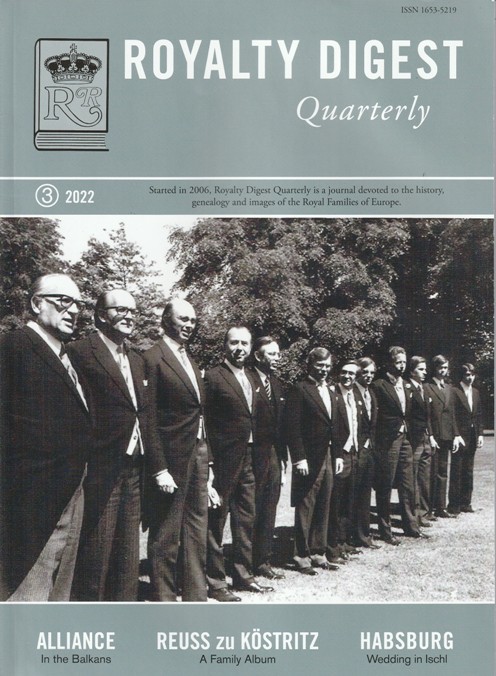
Royalty Digest Quarterly no. 3, 2022

I received my copy of Royalty Digest Quarterly no. 3, 2022 on 5 October 2022, but haven't had much time for blog activities since then. Some periods of the year are just more hectic than others. I have already received issue no. 4, so I better write a few words about no. 3 before I start reading the next issue. 

The front cover this time shows a photo of 12 princes of the Reuss. The main article in this issue is called Die Fürsten Reuss zu Köstritz – A Family Album and is written by the  magazine's editor, Ted Rosvall. He writes that «The Reuss zu Köstritz family is huge and extremely difficult to keep track of – not least because of the many inter-marriages between and within the various branches – and it is also very  difficult to find images of the various members. I have therefore chosen to focus on the more easily accessible branches and family members, describing this article as more of a collage than an album.» No reason to be so modest, I think Rosvall has done a good job in presenting the house and finding images. All in all I count 87 images of various family members and palaces. Rosvall gives an introduction to the dynasty and also presents 4 family tables. There is even a photo of Prince Heinrich XIII Reuss, b. 1951, who was arrested in December this year for allegedly having a leading role in the so-called coup d'état plot. A distant cousin, Prince Heinrich XIV Reuss, b. 1955, is today the head of the house. In an interview with BBC News, he said that «This outsider was ostracised years ago because of his outlandish conspiracy theories and antisemitic views. He's not representative of our family at all.» Rosvall might mention the black sheep in a future issue.

In his Editor's Corner, Rosvall of course writes about Queen Elizabeth II, who died on 8 September 2022, 96 years old. Rosvall writes among others: «Elizabeth II will go down in history as a straight-back and dutiful head of state who, against all odds, managed to hold together not only one nation but a large group of other countries within the Commonwealth.» He continues: «The Queen was also the epicenter  of constitutional monarchy, a form of government that has proven superior to most others. A counterweight to all the wretched dictators and tyrants currently plaguing our world, elected or not.»

The contents of the third issue this year:
  • Marlene A. Eilers Koenig: A Maritial Alliance. The Marriage of King Alexander of Yugoslavia and Princess Marie of Romania, pp. 1–12.
  • Stephen Bunford: The Murdering Prince, pp. 13–16.
  • Alexandre Tissot Demidoff & Richard Jay Hutto: The Karageorgevitch Twins. Princes or not ..., pp. 17–26.
  • Elizabeth Jane Timms: A Wedding in Ischl, pp. 27–34.
  • Ted Rosvall: Die Fürsten Reuss zu Köstritz - A Family Album, pp. 35–56.
  • Ove Mogensen: Tombs, Graves and Monuments in Thuringia. VII: Reuss zu Greiz (Ältere Linie), pp. 57–59.
  • Coryne Hall: Little-known Royals. Prince Georg of Denmark, pp. 60–61.
The issue also includes two book reviews – Michael L. Nash gives his view on Defenders of the faith. British Monarchy, Religion and the Next Coronation by Catherine Pepinster (Hodder & Stoughton, 2022), while the editor himself has written a review of Queen Victoria in Cornwall by Susan Symons (of German castles and palaces fame) (2022).

The World Wide Web of Royalty column this times gives us genealogical news from or about Bavaria, Belgium, Brazil, England (United Kingdom or at least Great Britain, it should have been), Hochberg/Pless, Mecklenburg and Württemberg.

If anyone wonders, the murdering prince in question was Prince Pierre Napoléon Bonaparte (1815–1881), the sixth child of Lucien Bonaparte, who was a younger brother of Emperor Napoléon. The wedding that took place in Ischl in 1890 was between Archduchess Marie Valerie of Austria (1868–1924), fourth child of Emperor Franz Joseph (1830–1848–1916), and Archduke Franz Salvator of Austria (1866–1939), son of Archduke Karl Salvator of Austria and Princess Maria Immacolata of Bourbon-Two Sicilies. The so-called Karageorgevich twins – Nicholas and Sergei – were born into the marriage of Prince Arsene Karageorgevich (1859–1938) and Princess Aurora Demidoff (1873–1904), but was the product of an affair Aurora had with Count Ernst Andreas von Manteuffel (1873–1953). 

All in all several articles worth reading this time as well. If you are not subscriber yet, information about Royalty Digest Quarterly can be found at its editor's website Royalbooks.se. See earlier presentations of RDQ here. See also its Facebook page.

18 January 2020

Royalty Digest Quarterly no. 4, 2019

I am not completely done with 2019 yet, because I have left to make a few comments on the latest issue of Royalty Digest Quarterly (no. 4, 2019). The magazine was waiting for me when I returned to Oslo on Boxing Day (that is 26 December for those who don't know the expression), so it must have arrived on either the 23rd or 24th of December while I was away). I would normally have written this blog article earlier this month, but January has been rather hectic with many royal events to comment on.

Ted Rosvall is not happy about the Swedish king's decision to take away the style Royal Highness for the children of Prince Carl Philip and Princess Sofia and of Princess Madeleine and Chris O'Neill, we learn when we read his Editor's Corner. Rosvall says that the title change is a breach of tradition and also finds it unneccessary. His main objection seems to be that the title changes are «retroactive or have retroactive effects» which are «contrary to all legal principles». Yes, I can see that objection, but I have argued earlier that the changes were bound to happen one day, and of course it would have been better if King Carl Gustaf had ruled out titles for his younger children's children before they were born. Constitutionally speaking it is much easier to give a title or another privilege than to take it away.

What about the front page? The photo shows Prince Victor Napoléon Bonaparte, his wife Princess Clémentine Bonaparte, née Princess of Belgium and their daughter Princess Marie Clothilde Bonaparte. The photo is the hint we need to know the topic of this issue's A Family Album. The magazine's historical consultant, Charlotte Zeepvat, is as always responsible for the introduction to the Bonapartes. In addition we get lots of photos - 80 portraits as well as two photos of  palaces and one of  St. Michael's Abbey in Farnborough, the last resting place of Emperor Napoléon III.

St. Michael's Abbey, Farnborough, England. Photo: Photochrom Print Collection/Wikimedia Commons.

The opening article, The Other Mrs. Simpson, is provided by Marlene A. Eilers Koenig. She tells the story of the American divorcee Romaine Simpson, née Pierce (1923–1975) and her marriage to David Mountbatten, 3rd Marquess of Milford Haven (1919–1970), a first cousin of Prince Philip, Duke of Edinburgh. They married in 1950 and divorced four years later. 

The next article starts with the quote «Geneva is my favourite place – I am safe there among cosmopolitians». Empress Elizabeth was tragically enough very wrong about her own safety while in Geneva. Elizabeth Jane Timms has written the article Empress Elizabeth if Austria and Geneva. The Visit of 1898, which ends with her assassination.

Then it is Douglas Scott Brookes to continue his series of excerpts from the memoirs of Prince Philipp zu Eulenberg – Two Emperors and One King on the Waters.

When commenting on issue 3, 2019 back in November last year, I thought that we had now come to the end of Bearn Bilker's article series The November 1918 Abdications, but I had obviously lost track of how many monarchs he had actually presented. This time he covers the abdications in Saxe-Meiningen, Saxe-Altenburg, Saxe-Coburg and Gotha, the Reuss elder and younger lines, Schwarzburg-Sondershausen and Schwarzburg-Rudolstadt. Prince Günther Victor (1852–1925) was the reigning Prince of both Schwarzburg-Sondershausen and Schwarzburg-Rudolstadt. On 23 November 1918 the prince gave consent to the abdication law passed in the Landtag of Schwarzburg-Rudolstadt, and two days later the time had come for Schwarzburg-Sondershausen, which, as the author points out, meant that the last monarchy to exist in Germany was in fact Schwarzburg-Sondershausen. This would also mean that we have come to the end of Bilker's very interesting series on the abdications in Germany in 1918.

Datiu Salvia Ocaña has made contributions to Royalty Digest Quarterly before, and now he has returned with the first part of The Six Stunning Infantas. The unexpexcted fortune of the daughters of exiled King Miguel I of Portugal. King Miguel also had a seventh daughter (actually his first), Maria da Assunçao de Bragança (1831–1887), who obviously will not get her story told in this series. But I like the idea of a presentation of the six infantas and look forward to reading the second part.

Another set of articles which returns regularly is Little-Known Royals, and in this issue Coryne Hall presents Prince Gustav of Denmark (1887–1944), the youngest son of King Frederik VIII and Queen Louise. I agree that Prince Gustav fits the bill, not many people today would know who he was or could tell much about him. Those of us who covers Europan royal history would know, but we are hardly representative.

Finally the readers are treated with genealogical news in the column The World Wide Web of Royalty. This time we get news from France (Bonaparte), Baden, Prussia, Two Sicilies and Württemberg.

Lots to read this time as well. If you are not a subscriber yet, I highly recommend you to join up! Information on Royalty Digest Quarterly can be found at its editor's website Royalbooks.se. See earlier presentation of RDQ here. See also its Facebook page.