Showing posts with label Prussia. Show all posts

20 August 2024

Royalty Digest Quarterly no. 2, 2024


The latest issue of Royalty Digest Quarterly - no. 2, 2024 – arrived in my mailbox on 4 July. It has been a busy summer, so I haven't much time to write a commentary until now.

The contents:
  • Olivier Defrance. A Life Without Tenderness. Princess Marie Louise of Bourbon-Parma II, pp. 1–10.
  • Martijn Arts: Sigismund and Charlotte Agnes of Prussia. From Palace to Nature, pp. 11–17.
  • Elisabeth Jane Timms: Losing Ludwig, pp. 18–28.
  • Bearn Bilker: The Princely House zu Wied – A Family Album, pp. 29–49.
  • Coryne Hall: Little-Known ROYALS. Prince Christian of Schaumburg-Lippe, pp. 50–52.
  • Stephen Bunford: The Pursuit of Pleasure - the Georgian Mistresses, pp. 53–62.
  • The World Wide Web of Royalty, p. 64.
The main cover photo is of Schloss Monrepos near Neuwied, one of the palaces of the Wied family, while the inserted photo is of  Princess (Fürstin) Marie, née Princess of  Nassau-Weilberg (1825–1902), who was married to Prince Hermann (1814–1836–1864). They were 4xgreat-grandparents of the current head, Prince Maximilian, b. 1999, if I have done my maths correctly.

Ted Rosvall opens his Editor's Corner this way: "The Duke of Sussex is now definitely "Persona non Grata" within the British Royal Family. This is hardly a secret and every new scandal seems to confirm it. Not to mention his easily hurt, spoiled and scheming duchess. Without being too harsh, one must probably conclude that their place in the cold is more than well deserved."

Well, we certainly agree that the ducal couple are "Persona non Grata". But I don't think it is fair to put all the  blame on them. The king, his brother and the media also have a share in my opinion, even if the couple has made the situation much worse by their TV interview, book publication etc. after moving to the States. It is all a very sad story ...

I feel that I have learned a lot about Princess Marie Louise of the Bulgarians, née Princess of Bourbon-Parma (1870–1899), wife of Prince Ferdinand (1861–1887–1918–1948) by reading Oliever Defrance's article, which was written with the collaboration of Joseph van Loon and Damien Bilteryst. What a sad marriage and what a selfish husband ...

Prince Sigismund (1896–1978), the second son of Prince Heinrich of Prussia (1862–1929) and a nephew of Emperor Wilhelm II, had an interesting life as a farmer in Guatemala and later in Costa Rica, together with his wife Princess Charlotte Agnes, née Princess of Saxe-Altenburg (1899–1989). I have read about them before, but it was a nice "return visit".

The article about king Ludwig II of Bavaria (1845–1886) by Elisabeth Jane Timms is based among others on the diary of Archduchess Marie Valerie (1868–1924), whose mother was Empress Elisabeth "Sissi" of Austria, née Duchess in Bavaria (1837–1898).

The main article of this issue is of course Bearn Bilker's Family Album of the House of Wied. The article follows the same pattern as previous family albums – a short introduction followed by a large collection of photos of various family members and then finally a genealogical table. Bilker could perhaps have mentioned Prince Wilhelm of Wied (1876–1945), who reigned as Prince (Mbret) of Albania for a short period in 1914, but at least it is mentioned in the genealogy (provided by Ted Rosvall, I gather?).

Prince Christian of Schaumburg-Lippe (1898–1974) was certainly not among the best-known members of royal Europe, and you would have to be very interested in royal history to know much about him these days. He was the son of Prince Friedrich (1868–1945), head of the Náchod branch, and Princess Louise of Denmark (1875–1906), the eldest daughter of Crown Prince, later King Frederik VIII) of Denmark (1843–1906–1912). Prince Christian, a first cousin of among others King Frederik IX of Denmark (1899–1947–1972) and King Olav V of Norway (1903–1957–1991), married his first cousin Princess Feodora of Denmark (1910–1975), eldest daughter of Prince Harald (1876–1949). Prince Christian and Princess Feodora's second son was the notorious Prince Waldemar (1940–2020), who caused so headlines of the years for the wrong reasons ...

When Stephen Bunford writes about "the Georgian Mistresses" he refers to the various Kings named George (of Hannover and the United Kingdom), but if you read the headline fast without thinking too much, you could easily wonder if the article was about mistresses from Georgia, and that would have made it more eccentric, wouldn't it?! Bunford doesn't hide the truth about King George IV: "[He] was an egotistical, romantic, dramatic, foolhardy, untruthful, narcistic, self-interested, self-absorbed sybarite." If you want to see the full list of George's over 70 known and alleged mistresses (and children) you should see Anthony Camp's website https://anthonyjcamp.com/pages/anthony-j-camp-nos-1-29.

Finally, the column The World Wide Web of Royalty this time brings you genealogical news of Hohenlohe-Öhringen, Lippe-Weissenfels, Schleswig-Holstein, Austria and Bavaria.

Information about Royalty Digest Quarterly can be found at its editor's website Royalbooks.se. See earlier presentations of RDQ here. See also its Facebook page. 

This article was last time updated on Tuesday 20 August 2024 at 21:20 (a link was corrected).

30 April 2024

Royalty Digest Quarterly no. 1, 2024


The latest issue of Royalty Digest Quarterly (no. 1, 2024) was waiting for me in the mailbox when I returned on 7 April 2024 from my visit to Tanzania. Since my return I haven't had that much time for blogging, but obviously I had to finish reading RDQ before I could start commenting.

The front cover shows a photo of the Ansbach Residence (Residenz Ansbach), also called Markgrafenschloss (Margrave's Palace). The choice of photo tells that this issue's Family Album will cover The Margraves of Brandenburg-Ansbach. I will return to the article later in the blog. 

Main contents:

  • Olivier Defrance: A Life Without Tenderness. Princess Marie Louise of Bourbon-Parma. [Part] 1, pp. 1–10
  • Martijn Arts: Princess Alexandra Victoria of Schleswig-Holstein-Glücksburg. A Princess in a Caravan, pp. 11–15.
  • Elizabeth Jane Timms: Friedrich Wilhelm of Hesse (1870-1873), pp. 16–22.
  • Ted Rosvall: The Margraves of Brandenburg-Ansbach. A Family Album, pp. 23–35.
  • Susan Symons: The Last Margrave of Brandenburg-Ansbach, pp. 36–41
  • Ove Mogensen: Tombs, Graves and Monuments in Prussia, pp. 42–51.
  • Coryne Hall: Little-known ROYALS. Princess Henriette of Belgium, Duchess de Vendôme, pp. 52–53.
  • David Horbury: Queen Elizabeth II and Greece, pp. 55–60.
  • Ted Rosvall/Anne-Karin Schander: Royal Bustards. The Princes of Lapland. King Oscar I and Emilie Högqvist, pp. 61–62.
  • The World Wide Web of Royalty, p. 64 [this time including news about/from Albania, Fürstenberg, Italy, Luxembourg, Romania, Schaumburg-Lippe and Württemberg].
On p. 63 there is an ad for the royal history conference in Leeuwarden, the Netherlands, in October. I have paid for the flight and conference fee and got a hotel room reservation, so I look very much forward to the conference and hope to see as many old (and new) friends and acquaintances as possible. Go here for more details about the conference. 

The shocking abdication of Queen Margrethe II in January this year is the topic of Ted Rosvall's  Editor's Corner. He gives examples of abdications in other European countries and writes that "[...] in the Nordic countries, Margrethe's decision may be seen as an innovation, even though there was in fact a precedence. In 1654, Queen Christina of Sweden, actually did the same." That is absolutely correct. What Rosvall didn''t mention, was the abdication of the Danish King Erik III Lam in 1146. We are of course only talking about voluntary abdications. In Norway there were abdications in 1814 (King Christian Frederik) and in 1905 (King Oscar II), and neither had much choice in the matter. I only hope that Queen Margrethe's choice will not be followed up in the other Nordic monarchies.

The historian Oliver Defrance, with the colloboration of Joseph van Loon and Damien Bilteryst, has written about Princess Marie Louise of Bourbon-Parma (1870–1899), the first wife of of Prince and later King Ferdinand of the Bulgarians (1861–1948). The writers tell that they among others have based their article among others on an archive which has been little used until now : "[...] we have reread the existing works – old and new – on the Court of Bulgaria. We have gone trhough the press of the period, often rich with information, and we have made small surveys in an archive which has been little used until now: the Fonds Coburg, kept in the State Archives in Vienna". The result is a good and detailed biographical sketch of Princess Marie Louise, and I am already looking forward to part II.

I have often commented on the choices Coryne Hall has made for her column Little-Known ROYALS. I wonder if Princess Alexandria Victoria of Glücksburg (1887–1957) would also have been a good candidate. Of course my question marks some times tell as much about my own knowledge level. More important is that Martijn Arts has written an informative and amusing article about Princess Alexandria Victoria, the second eldest daughter of Duke Friedrich Ferdinand of (Schleswig-Holstein-Sonderburg-)Glücksburg (1855–1934) and Princess Caroline Mathilde of (Schleswig-Holstein-Sonderburg-)Augustenburg (1860–1932, the latter a niece of Empress Augusta Victoria, wife of Empreror Wilhelm II, while the former was a cousin of KIng Frederik VIII of Denmark. Princess Alexandria Victoria married Prince August Wilhelm of Prussia (1887–1949) in 1908 and divorced him in 1920. They had one child, Prince Alexander Ferdinand (1912–1985). The princess then married Arnold Rümann (1884–1951) in 1922, but also this marriage ended in divorce. She had a long career as an artist and for some time traveled around in the USA in a caravan. She lost all her paintings when Russia occupied the area where they were stored during WW2. I wonder how talented she really was and how much one would have to pay for any paintings that still exist? I note that one of her works was put on auction last year.

Royalty Digest Quarterly has covered all the all the still existing reigning and non-reigning royal and princely houses of Europe in the article series A Family Album and now it seems that houses that for various reasons have died out will also be covered. In this issue we learn more about The Margraves of Brandenburg-Ansbach. Somewhat confusing is the fact that the principality was also referred to as a margraviate and that the head was a margrave. There might be some historical details here that I have missed. Anyway, the last reigning Prince and Margrave (!), Karl Alexander (1736–1806), who was also sovereign of Brandenburg-Bayreuth, sold his principalities to King Friedrich Wilhelm II of Prussia in 1791. The childless margrave then moved to England with his second wife. As usual the family album gives a short introduction as well as quite a few photos/paintings – 55 in all (if a photo of  the Royal Family of Great Britain containing as many as 9 portraits should be counted as 9, and not just 1) – of various family members, palaces and tombs. The most famous descendant was Margravine Karoline of Brandenburg-Ansbach (1683–1737), who in 1705 married Georg Augustus of Hannover, who became King George II  of Great Britain and Ireland in 1727. One page 35 there is a select family tree of the house of Brandenburg-Ansbach.

The expert on German palaces, Susan Symons, then follows up with the article The Last Margrave of Brandenburg-Ansbach. The article, however, also gives many details about the above-mentioned Karoline/Caroline and even about Kaspar Hauser, who claimed to be a lost prince and the rightful ruler of Baden, because there is a memorial to him in the gardens of Ansbach Palace. When the former margrave moved to England after he had sold his principalities, he bought Brandenburgh House at Fulham, London as well as Benham Park near Newbury in Berkshire. It was at the latter country home that the margrave died in 1806. According to the Wikipedia article, "a memorial in St Mary's Church in Speen, simply records "In Memory of the Margrave of Anspach, who died at Benham 5th January 1806", but it doesn't say exactly where he is buried. Same thing could be asked about his wife Elizabeth, Princess Berkeley (b. London 1850–d. Naples, Italy 1828), née Lady Elizabeth Berkeley and formerly married to the 6th Baron Craven. The Wikipedia article about her, however, state that she was buried in the English cemetery in Naples. As for Brandenburgh House, it was demolished some time after the property was sold in 1822, and today the property, called Fulham Reach, consists of several buildings with luxury apartments. Not the worst place to live, I guess.


The Royal Mausoleum in Charlottenburg Palace Park, Berlin. © 2008 Dag Trygsland Hoelseth.


Grave of Queen Louise of Prussia, née Princess of Mecklenburg-Strelitz (1776–1810). © 2008 Dag Trygsland Hoelseth.


Grave of Friedrich der Grosse/Frederick the Great at Sanssouci, Potsdam. © 2011 Dag Trygsland Hoelseth.

The reason for including the grave photos above is of course due to Ove Mogensen's very informative article Tombs, Graves and Monuments in Prussia. Is there any royal burial place he has not been to?  I visited Charlottenburg Palace and the royal mausoleum (Luisenmausoleum) in February 2008. As far as I remember the main hall with the sarcophaguses was closed at the time due to renovation, so I could only visit the crypt, but that was of course where the royals were actually buried. I would have to return one day to see more of Berlin and Potsdam as well as the many burial places. I visited the crypt in Berlin Cathedral in 2011, so I might return with a blog article from that visit another time.

There are so many interesting articles in this issue, but I choose not to comment on all of them. But I have enjoyed reading them all, and cannot recommend a subscription enough! Information about Royalty Digest Quarterly can be found at its editor's website Royalbooks.se. See earlier presentations of RDQ here. See also its Facebook page. 

12 February 2022

Royalty Digest Quarterly no. 4, 2021

I received the latest issue of Royalty Digest Quarterly – no. 4, 2021 – about a month ago, so obviously it is on time to write a few words. The red color of the front cover seems darker in print than in the photo published at the RDQ Facebook group. The image is of the Swedish Royal Family in 1905, showing (standing) Prince Eugén, Prince Oscar and Princess Ebba Bernadotte, Prince Wilhelm, Princess Margaretha, Prince Gustaf (VI) Adolf,  Crown Princess Victoria, Prince Erik, Crown Prince Gustaf (V) and Prince Carl and in front (sitting) Princess Therese,  Queen Sophie, King Oscar II and Princess Ingeborg with her daughters Princess Märtha and Princess Margaretha. The front cover image tells the readers that Sweden is the topic of the traditional Family Album, this time written by the editor Ted Rosvall himself instead of the magazine's historical consultant Charlottge Zeepvat. As always the readers are treated with a short introduction in addition to a large selection of images of royals and palaces as well as genealogical tables. Rosvall has already mentioned a few mistakes in the genealogical table on page 33. It is a bit ironic that such (minor) mistakes have been made by the world's Bernadotte genealogy expert no. 1, but as they say, it can happen to the best of us!

In his Editor's Corner Ted Rosvall gives a warm thank you note to alle the contributions Charlotte Zeepvat has made to the magazine both as an editorial consultant and as a writer of numerous articles. The way the column is worded one starts to wonder whether this means that Zeepvat has stepped down as historical consultant, but I can't find any explicit mentioning of this.

Datiu Salvia Ocaña has this tine written an interesting piece titled The Demidoffs and the Royals. The Russian noble family has interesting connections to the imperial and royal houses of France-Bonaparte and Serbia-Karadjordjevic. I learn a lot from this article, but there are quite a lot of names, so I wonder if the article would be easier to read with the help of a genealogical survey.

Another interesting article in this issue is The Very Short Reign of Boris I, which gives the story of Boris Skosyrev, who in 1934 proclaimed himself King of Andorra! The author is Michael Nash, who has made numerous contributions to RDQ before.

Charlotte Zeepvat then returns with A Long Chain of Persecutions. Princess Luise Sophie of Schleswig-Holstein and Prince Friedrich Leopold of Prussia. Part 2: The Children's Story. I commented on the first part in January. As I wrote then, the couple in question is Princess Luise Sophie (1866–1952), the sixth child of Duke Friedrich of Schleswig-Holstein-Sonderburg-Augustenburg (1829–1880), by his wife Princess Adelheid of Hohenlohe-Langenburg (1835–1900). Luise Sophie married in 1889 Prince Friedrich Leopold of Prussia (1865–1931). One of Princess Luise Sophie's brothers-in-law was Emperor Wilhelm II, who caused so much misery in the family. Luise Sophie and Friedrich Leopold had four children –Viktoria Margarete «Agra»  (1890–1923, who married (and later divorced) Prince Heinrich XXXIII Reuss (1879–1942), Friedrich Sigismund (1891-1927),who married Princess Marie Luise of Schaumburg-Lippe (1897–1938), Friedrich Karl (1893–1917) and Friedrich Leopold (1895–1959). Viktoria Margarete and Friedrich Sigismund gave Luise Sophie and Friedrich Leopold four grandchildren. I guess there were great-grandchildren as well, but it might take some time to figure out the number. Many tragedies in this family. And the article is so well written and researched.

Eric Lowe has contributed with the article Elegant Royals – Some favorites from my collection. Lowe has a large collection of photos of royalty and is also a photographer himself. He is also the administrator of the Facebook group Elegant Royals, which has more than 2700 members.

The series Little-Known Royals is continued in this issue as well, and Coryne Hall has this time written about Princess Josephine Caroline of Belgium (1872–1952), who married Prince Karl Anton of Hohenzollern(-Sigmaringen) (1868–1919) in 1894. There were four children in this marriage and many grandchildren. There is an interesting article (no date given) about this family in Deutsches Adelsblatt titled Ein Konzert rettet die Burg.

The column The World Wide Web of Royalty this time gives us genealogical news about the non-royal part of the Bernadotte family, Bourbon-Parma, Hohenlohe-Langenburg, Russia, Schaumburg-Lippe and Schleswig-Holstein (Glücksburg).

Information about Royalty Digest Quarterly can be found at its editor's website Royalbooks.se. See earlier presentations of RDQ here. See also its Facebook page.

5 January 2022

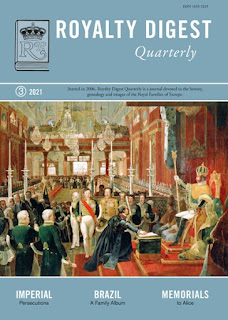
Royalty Digest Quarterly no. 3, 2021

I received the third issue of Royalty Digest Quarterly ages ago, and as the fourth issue is just around the corner, I thought it was on time to write a few words. I have several periodicals in line to be commented on, so stay tuned for the next few weeks ...

My first impression: What a beautiful cover! Both the greyish-blue cover and the photo – of the coronation of Emperor Dom Pedro I of Brazil on 1 December 1822 in the Old Cathedral of Rio de Janeiro – look great. The photo is followed up by Charlotte Zeepvat's article  The Imperial House of Brazil – A Family Album. Besides the introduction to the Brazilian imperial family the readers can enjoy nearly 100 illustrations of various family members and residences. There are many reasons why I would like to visit Brazil one day – the imperial summer palace at Petrópolis is one of them – it just looks splendid! In addition to the illustrations there are also four pages of genealogical tables.

Charlotte Zeepvat's second contribition is the article A Long Chain of Persecutions. Princess Luise Sophie of Schleswig-Holstein and Prince Friedrich Leopold of Prussia. Part I: A Divided Family. The couple in question is Princess Luise Sophie (1866–1952), the sixth child of Duke Friedrich of Schleswig-Holstein-Sonderburg-Augustenburg (1829–1880), by his wife Princess Adelheid of Hohenlohe-Langenburg (1835–1900). Luise Sophie married in 1889 Prince Friedrich Leopold of Prussia (1865–1931). Her elder sister Auguste Viktoria (1858–1921) was the first wife of Emperor Wilhelm II (1859–1941), and who caused the long chain of persecutions. It is almost unbelieveble how badly treated the princess and her husband were. I look forward to reading the second part.

Other articles:

  • Memorials to Princess Alice, Grand Duchess of Hesse by Elizabeth Jane Timms
  • A Devoted Servant – Albert Latapie by Alberto Penna Rodrigues
  • Tombs, Graves and Monuments in Thurungia. V: Schwarzburg-Sondershausen by Ove Mogensen
  • Little-Known Royals. Prince Peter of Greece by Coryne Hall
  • The World Wide Web of Royalty. Births, marriages, deaths and other events in the Royal Families of Europe
The latter column includes news from Austria, Bentheim-Steinfurt, Liechtenstein. Schaumburg-Lippe and Bourbon-Two Sicilies. The aforementioned Albert Latapie (b. 1877) was employed by Princess Isabel of Brazil and her husband Count d'Eu and their children. The article contains extracts of his memoirs.

All in all the issue had several most readable articles and fortunately I don't have to wait long for the fourth and last issue of 2021 to arrive.

Information about Royalty Digest Quarterly can be found at its editor's website Royalbooks.se. See earlier presentations of RDQ here. See also its Facebook page.

19 October 2018

Royalty Digest Quarterly no. 3, 2018

I really enjoyed the latest issue of Royalty Digest Quarterly (no. 3, 2018). There were several articles about royals and royal families that I knew little about, so I felt I got full value this time, and I trust that other readers feel the same.

The five daughters of Heinrich XXII, Prince (Fürst) Reuss zu Greiz, adorn the front page this time, meaning that Charlotte Zeepvat has devoted her traditional Family Album to the House of Reuss zu Greiz. The daughters were Emma, Marie Agnes, Karoline, Hermine and Ida. The latter is surely the one in the middle, while I will not make a guess on the others. Hermine (1887–1947) is the most famous of the sisters, as she in 1922 married the exiled Emperor Wilhelm II. She was previously married to Prince Johann Georg of Schoenaich-Carolath (1873–1920) and had 5 children by him. Interestingly enough, a second cousin of Prince Johann Georg, Princess Karin-Elisabeth (1900–1966) married in 1933 the Norwegian banker Christoffer Blom Heimbeck (1885–1967). They were both members of the Norwegian nazi party Nasjonal Samling during WW2, but that is a story I will get into another time. Karin-Elisabeth and Christoffer's eldest daughter Ingrid (1934–2016) was in 2000 married to her second cousin Count Wolfgang von Schimmelmann (1921–2004). Of course none of this was mentioned in Zeepvat's article, I just get carried away here because of the Norwegian connections. There might be other family connections between Hermine Reuss zu Greiz and the Schoenaich-Carolaths which make the connection between her and Karin-Elisabeth closer than through her husband, but I haven't got the time to look into it right now. Two of Hermine's children were present at the Heimbeck wedding, I should add. But I cannot forget to mention that the said Reuss sisters had a brother, Prince Heinrich XXIV (1878–1927), who was the last (at least in name) reigning Prince (Fürst) of the small Reuss zu Greiz principality. According to Zeepvat, «the mental and physical disabilities he suffered as the result of a childhood accident made him incapable of reigning», and his regent was originally Heinrich XIV, Prince (Fürst) Reuss zu Schleiz (1832–1913). I gather that his son Heinrich XXVII (1858–1928) was the second regent.

Anyway, Zeepvat tells the story of the Reuss elder line and all the Heinrich princes (all the princes are named Heinrich followed by numerals which were supposed to go up to 100 before it would start all over with no. I again, it never did as the house died out with Heinrich XXIV mentioned above. In addition to the introduction to the Reuss zu Greiz family, the readers are treated with 43 illustrations of various family members and palaces, as well as two pages with genealogical tables. The first shows one (of surely many more) connection between Reuss zu Greiz and the Norwegian Royal Family.

But before we come as far as to the Family Album, Charlotte Zeepvat has also made another contribution, 'My Dear Miss Howard. Serving the Kaiser's family', which tells the story of Ethel Howard (1865–1931), who served as the governess of Emperor Wilhelm II and Empress Auguste Victoria's elder sons from 1895 to 1897, while from 1900 to 1908 she was in charge of the upbringing and education of five orphaned Japanese princes! She later published her memoirs (Potsdam Princes, 1916, and Japanese Memories, 1918, but the article is mainly based on a collection of her papers which have recently emerged on the collector's market.

Before the Reuss article starts, the readers have arrived at column The World Wide Web of Royalty, which usually is placed at the end of each issue, but this time appears quite early on. Anyway, the column this time gives us genealogical news from the imperial, royal or princely houses of Austria, Denmark, Bourbon-Parma, Mecklenburg-Strelitz, Saxony, Saxe-Coburg and Gotha, Solms-Laubach, Waldeck and Pyrmont and Thurn and Taxis.

Following the Reuss article, Michael L. Nash takes over with the article The Belle of the Coronation Ball. Emperor Alexander II had succeeded the year before, but because of the ending of the Crimean war, the coronation was delayed. The belle of the ball was Princess Ekaterina Dadiani (1816–1882), née Chavchavadze, who served as Regent of Mingrelia (Western Georgia) for some time. Not often we can read about the various monarchies and reigning families in Georgia, so this was an interesting encounter.

Queen Marie of Bavaria, née Princess of Prussia (1825–1889) had a life-long love of the mountains, of climbing and hiking, and Elizabeth Jane Timms takes us to Marie's retreat in Elbigenalp in the Austrian state of Tyrol.

It is not the first time that Royalty Digest Quarterly provides an article about the royal family of Montenegro, but I am confident that it is the first time that Jutta, née Duchess of Mecklenburg-Strelitz (1880–1946) is portraited. The author is Marlene A. EIlers Koenig. Jutta was married to Prince Danilo of Montenegro in 1899 and took the name Militza following her conversion to Orthodoxy. WW1 and later Montenegro's incorporation into the Kingdom of Serbs, Croats and Slovenes (later Kingdom of Yugoslavia) forced Danilo and Militza into exile. They lived rather separate lives. Danilo died in Vienna in 1939. Militza lived in France and later in Italy, where her sister Elena was Queen, and died in Rome in 1946. Koenig mentions that Militza was buried at the Non-Catholic Cemetery for Foreigners in Testaccio, Rome, i.e. Il Cimitero Acattolico di Roma. I might not have paid enough attention to Militza's life in exile, as the information on her place of burial was new to me. I visited the cemtery around a year ago and thought I had prepared well for the visit! I can't find Jutta or Militza's name listed at the website at all. I photographed numerous graves of people of Norwegian or Scandinavian origin, including the last resting places of the historian Peter Andreas Munch (1810–1863), in addition to the grave of Prince Felix Youssoupoff (1856–1928), the grave of the poet John Keats (1795–1821) and many others. When you visit the cemetery, you are able to search for the names of all the people buried there, but as I didn't know of Militzia's grave, I never looked for it. Surely I must have passed the grave, but when looking at a photo of it tonight, I must say it was certainly not a headstone that would scream out for my attention. Well, well, it only means that I have to visit the cemetery again another time.

Speaking of royal graves, the Danish Ove Mogensen has for many years taken a great interest in this topic, and there is hardly a royal grave he hasn't been to. Well, not to the grave of Karin-Elisabeth Heimbeck, Princess of Schoenaich-Carolath, I am sure! But anyway, I just love his articles on royal graves, and his contribution Tombs, Graves and Monuments. Burial Places of the Bonaparte Dynasty [Part] I certainly didn't disappoint me. I look forward to reading the second part!

Coryne Hall then gets the honor of providing the last article of the present issue, Prince Ataulfo of Bourbon-Orleans (1913–1974) in the series Little-Known Royals. He certainly deserved the description little-known, and Hall gives a good survey of his miserable life. Ataulfo, his brothers and parents, Infante Alfonso, Duke of Galliera (1886–1975) and Beatrice of Saxe-Coburg and Gotha (1884–1866) are buried in the Capuchin convent in Sanlúcar de Barrameda, Spain, yet another place I hope to visit one day.

Information on Royalty Digest Quarterly can be found at its editor's website Royalbooks.se. See earlier presentation of RDQ here. See also its Facebook page.  

21 January 2013

Prince Georg Friedrich and Princess Sophie of Prussia parents

It was announced at the official website of the House of Hohenzollern today that Princess Sophie, wife of the head of the Prussian Royal Family, Prince Georg Friedrich, gave birth to twin boys on Sunday 20 January 2013 in Bremen, Germany.

The twins are named Carl Friedrich and Louis Ferdinand. The announcement in full (in German only):
Mit großer Freude und Dankbarkeit gibt der Chef des Hauses die Geburt seiner Söhne Carl Friedrich und Louis Ferdinand bekannt, die am 20. Januar 2013 in Bremen zur Welt gekommen sind. Prinzessin Sophie und die Zwillinge sind wohlauf.
Prince Georg Friedrich of Prussia and Princess Sophie of Prussia, née Princess of Isenburg, were married at Potsdam outside Berlin on 25 August (civ.)/27 August (rel.) 2011. Prince Georg Friedrich is a great-great grandson of Emperor Wilhelm II.

22 January 2011

Head of the Royal House of Prussia engaged

The engagement between the head of the Royal House of Prussia, Prince Georg Friedrich, and Princess Sophie of Isenburg, has been announced at the official website Preussen.de.

Prince Georg Friedrich, b. Bremen 10 June 1976, is the only son of the late Prince Louis Ferdinand of Prussia (1944-1977) and the then Princess Donata, née Countess of Castell-Rüdenhausen, and succeeded his grandfather Prince Louis Ferdinand (1907-1994) as head of the Royal House of Prussia in 1994. The last-mentioned Prince Louis Ferdinand was a grandson of Wilhelm II, German Emperor and King of Prussia (1859-1888-1918-1941), which of course means that Prince Georg Friedrich is a great-great grandson of the last Emperor. After the younger Prince Louis Ferdinand's death in 1977, his widow married (in 1991) Duke Friedrich August of Oldenburg.

After finishing his military service, Prince Georg Friedrich studied business administration at the University of Freiberg and is currently working "for a company specialized on marketing of academic innovation".

Princess Sophie of the mediatised house of Isenburg, b. Frankfurt 7 March 1978 is the fourth child of Prince Alexander of Isenburg and his wife Princess Christine, née Countess von Saurma and Baroness (Freiin) von und zu der Jeltsch.(*) This means that the Prussian head is to enter an "equal" marriage, which we don't see so often these days. Princess Sophie has according to the press release studied business administration in Freiberg and Berlin and today works for a consulting company for public benefit organisations ("gemeinnützige Organisationen") in Berlin.

The wedding is expected to take place later in 2011, probably at Potsdam.

(*) If anyone wonders, I tend to translate prepositions ("nobiliary particles"/"Adelsprädikate") like "von", "zu", "de" etc. into English for persons who belong to reigning or former reigning royal and princely houses, including mediatised houses, but not for members of noble families (like von und zu der Jeltsch).

Blogglisten