29 August 2019

Norway: Princess Ingrid Alexandra's confirmation

Princess Ingrid Alexandra's confirmation will take place in the Palace Chapel in Oslo on Saturday 31 August 2019 at noon.

The princess has received her confirmation instruction at the Asker Church congregation under the direction of Provost Tor Øystein Våland and Vicar Karoline Astrup. The confirmation service in the Palace Chapel will be officiated by the Bishop of Oslo, Kari Veiteberg, and the Praeses of the Norwegian Bishops’ Conference, Bishop Helga Haugland Byfuglien.

After the confirmation service, Princess Ingrid Alexandra's grandparents King Harald and Queen Sonja will host a luncheon in the Banqueting Hall of the Royal Palace.

Guest list
The Royal Palace released today part of the guest list:

The part of the guest released to the public is limited to members of the royal family, sponsors, other family members of the princess, the official Norway, the Church of Norway, the Diplomatic Corps and various organisations.

The Royal Family
  • King Harald (sponsor)
  • Queen Sonja
  • Crown Prince Haakon
  • Crown Princess Mette-Marit
  • Princess Ingrid Alexandra
  • Prince Sverre Magnus
  • Marius Borg Høiby
  • Princess Märtha Louise (sponsor)
  • Maud Angelica Behn
  • Leah Isadora Behn
  • Emma Tallulah Behn
  • Princess Astrid Mrs. Ferner
Other sponsors
  • King Felipe of Spain
  • Crown Prince Frederik of Denmark 
  • Crown Princess Victoria of Sweden
  • Marit Tjessem
Other royals
  • Crown Princess Mary of Denmark
  • Prince Christian of Denmark
The official Norway
  • President of the Storting Tone Wilhelmsen Trøen and Per Kristian Trøen
  • Prime Minister Erna Solberg and Sindre Finnes
  • Chief Jusstice of the Supreme Court Toril Marie Øie and Rune Brekke
  • First Vice President of the Storting Eva Kristin Hansen
  • Finance Minister Siv Jensen
  • Culture minister Trine Skei Grande
  • Children and Families Minister Kjell Ingolf Ropstad
  • Second Vice President of the Storting Morten Wold
  • Third Vice President of the Storting Magne Rommetveit 
  • Fourth Vice President of the Storting Nils T. Bjørke
  • Fifth Vice President of the Storting Abid Q. Raja
  • Parlamentary leader Trond Helleland
  • Parlamentary leader Hans Fredrik Grøvan
  • Parlamentary leader Marit Arnstad
  • Party leader Trygve Slagsvold Vedum
  • Plenary leader of Sametinget (Sámi Parliament) Tom Sottinen
  • President of Sametinget (Sámi Parliament) Aili Keskitalo
  • Permanent Secretary to the Government Anne Nafstad Lyftingsmo
  • County Governor Valgerd Svarstad Haugland
  • The mayor of Oslo, Marianne Borgen
  • The mayor of Asker, Lene Conradi
  • Chief of Defence, Admiral Haakon Bruun-Hanssen
  • Commander of His Majesty The King's Guard, Lieutenant Colonel Vegard Flom 
  • National Police Commissioner Benedicte Bjørnland
  • Police Commissioner of Oslo Beate Gangås
  • Chief of the Royal Police Escort, Roy Hagen-Larsen
Diplomatic corps
  • Ambassador of Myanmar, Maw Maw, doyen (dean)
  • Ambassador of Sweden, Krister Bringéus
  • Ambassador of Denmark, Jarl Kåre Frijs-Madsen
  • Ambassador of Spain, Maria Isabel Vicandi
The Church of Norway and other religious communities
  • The Praeses of the Norwegian Bishops’ Conference, Bishop Helga Haugland Byfuglien
  • Bishop Kari Veiteberg
  • Cathedral cantor (domskantor) Kåre Nordstoga
  • Provost of Asker Tor Øystein Vaaland 
  • Vicar of Asker Karoline Astrup
  • Head of the Church Council Kristin Gunleiksrud Raaum
  • Chairperson of the Council for Religious and Life Stance Communities, Britt Strandlie Thoresen
  • General Secretary of the Council for Religious and Life Stance Communities, Ingrid Rosendorf Joys
  • Youth Representative of the Council for Religious and Life Stance Communities and the Muslim Dialogue Network, Yasmine Fatima Angell Morchid
  • Youth representative of the Council for Religious and Life Stance Communities, board member of Norway's Young Catholics, Martin Bao Anh Vo 
  • Youth representative of the Council for Religious and Life Stance Communities
  • Youth representative of the Council for Religious and Life Stance Communities, commitee member Norwegian Humanist Youth, Iver Daaland Åse 
  • Head of the Church Council's Commitee for youths, Ufung, Silje Håve Smørvik
  • Bishop emeritus Gunnar Stålsett and Unn Stålsett
Organisations
  • Chief executive officer Ole Erik Almlid, NHO (Confederation of Norwegian Enterprise)
  • Chairperson Hans Christian Gabrielsen, LO (Norwegian Confederation of Trade Unions)
  • Chairperson Rode Margrete Hegstad, LNU (The Norwegian Children and Youth Council)
  • Chief agent Are Shaw Waage,  Miljøagentene (The Eco-Agents)
Family
  • Juliane Snekkestad (partner of Marius Borg Høiby)
  • Espen and Renate Høiby with children
  • Christian Høiby
  • Ina Høiby and Mads Hvilshøj
  • Tuva Høiby
  • Per Høiby and Louise Dedichen
  • Anette Bastviken
  • Susanne K. Dedichen Bastviken
  • Julie Høiby and Teodor C-G Teigen
  • Joachim Høiby and June Bolme
  • Kristin Høiby
  • Kamilla Høiby Bjørnøy
  • Maria Viig Bjørnøy and Are Hoel
  • Anniken Høiby Bjørnøy
  • Erling Lorentzen (widower of Princess Ragnhild) and his partner, Ebba Løvenskiold
  • Cathrine Ferner Johansen (eldest daughter of Princess Astrid) and Arild Johansen
  • Lis Haraldsen (sister-in-law of Queen Sonja)
  • Ian Swanstrøm (niece of Queen Sonja) and Carl Christian Dahl
  • Tom Ivar Junker
  • Janne Cecilie Junker
  • Elsie Sargeant
Erling Lorentzen, the widower of Princess Ragnhild, used to be listed in the Royal Family section also after his wife's death, but seems to have been removed 3–4 years ago, probably when he got a new partner.

Updated last time on Friday 30 August 2019 at 00.20 (minor correction).

16 August 2019

Death of Princess Christina of the Netherlands

The Dutch Royal Court announced today the death of Princess Christina of the Netherlands, youngest of the four daughters of Princess Juliana and Prince Bernhard. She was thus the youngest sister of Princess Beatrix, who abdicated as Queen of the Netherlands in 2013, and an aunt to King Willem-Alexander.

Princess Christina, who was born at Soestdijk Palace in Baarn on 18 February 1947, died at the Noordeinde Palace complex in The Hague in the morning of 16 August 2019, after having suffered from bone cancer for several years.

The princess married in 1975 the Cuban-born Jorge Pérez y Guillermo and had 3 children by him – Bernardo (b. 1977, Nicolas (b. 1979) and Juliana (b. 1981) as well as 5 grandchildren. Princess Christina was excluded from the line of succession to the Dutch throne by not seeking and obtaining consent by Act of Parliament, cf. the Dutch Constitution Article 28 (2). All descendants are thus also excluded. Princess Christina and Guillermo divorced in 1996. Princess Christina, who for the main part had lived in New York and in Italy for many years, was an accomplished singer and had studied vocal teaching. In later years she took an interest in dance therapy and sound therapy.

According to the press release, «Princess Christina’s remains will be taken to Fagel’s Garden Pavilion in the grounds of Noordeinde Palace, where close friends and family will pay their last respects. The cremation will be held in private.»  According to Netty Leistra at Nobiliana.de (thread «Prinses Christina der Nederlanden»,  Death Announcements Gotha 2019) the private ceremony and cremation will take place on 22 August 2019.

14 July 2019

Royalty Digest Quarterly no. 2, 2019

The latest issue of Royalty Digest Quarterly arrived in my mailbox two weeks ago or so. The green and beautiful cover includes an image of the French royal family in 1823, showing from left to right Marie Thérèse, Duchess of Angouleme, Louis Antoine, Duke of Angouleme, Henri, Duke of Bordaux in the arms of his grandfather Charles, Duke of Artois, in front Louis XVI, Louise Marie Thérèse of Artois and her mother the Duchess of Berry.

We are in other words going French this time, with the traditional Family Album by Charlotte Zeepvat covering The Royal Houses of France, Part I, The House of Bourbon – Henri IV to Henri V. I count 99 images of various members of the House of Bourbon and of the palace of Versailles, in addition to 3 pages with family tables.

Charlotte Zeevat, the historical counsultant to Royalty Digest Quarterly, has also made another large contribution, 'Dearest Millie'. Letters to a royal nurse, telling the story of Millicent Elizabeth Crofts (1852–1941), who from the 1870s until 1887 was a nurse to the children of Grand Prince Vladimir of Russia and his wife Grand Princess Marie, née Duchess of Mecklenburg-Schwerin: Kirill (1876), Boris (1877), Andrei (1879) and Elena (1882) and perhaps also the eldest, Alexander (1875). The article is based on the collection of Millicent Croft's papers sold by auction by Lyon & Turnbull in Edinburgh in February 2018. It is both a well researched and well written article which I enjoyed very much.

Another great contribution this time is Stefan Haderer's article The Baltazzis. A family's rise and fall in the Habsburg Empire. The Baltazzis was a prominent family of Levantine origin, Phanariot Greeks from Constantinople who were close both the the court of Constantinople and later of Vienna. Theodore and Eliza Baltazzi had 10 children, of whom the eldest Elizabeth «Lizzie» married Albert Llewellyn Nugent,3rd Baron Nugent, while the second oldest Helen married Baron Albin Vetsera. Their daughter Marie (Mary) (1871–1889) was a mistress to Crown Prince Rudolf (1858–1859) and killed at Mayerling in 1889, a tragedy that of course explains the fall of the Baltazzis from the court in Vienna. The website of the Levantine Heritage Foundation, has, by the way, a collectionn of Baltazzi documents at their website which is worth having a look at. The Baltazzi family had many other interesting connections as well. Christopher Long has worked on the family's genealogy, but it doesn't seem to be available at the moment. Haderer's article is really interesting, please read it! More of this!

And if this is not enough, Bearn Bilker continues with the 3rd part of his The November 1918 Abdications in Germany, this time covering grand duchies of Baden and Oldenburg and the duchy of Anhalt.

Bilker has also made a second contribution to the issue, Woizlawa-Feodora. Royal Centenarian, which also is worth reading. Princess Woizlawa-Feodora Reuss, née Duchess of Mecklenburg, only daughter of Duke Adolf Friedrich of Mecklenburg (1873–1969) and his first wife Priness Victoria Feodora Reuss (younger line) (1889–1918), was born on 17 December 1918 and celebrated her 100th birthday last fall, with among others the author present at the party. Woizlawa-Feodora was in 1939 married to Prince Heinrich I Reuss (1910–1982) of the younger line and had 5 sons and one daughter. As Grand Duke Adolf Friedrich was a brother to Heinrich, who in 1901 married Queen Wilhelmina of the Netherlands, Princess Woizlawa-Feodora was a first cousin to Queen Juliana and was a bridesmaid to her wedding to Prince Bernhard of Lippe-Biesterfeld. Princess Woizlawa-Feodora sadly passed away on 3 June 2019.

Finally, the readers are treated with the traditional column The World Wide Web of Royalty, which this time has genealogical news of the Imperial, Royal, Princely and/or Mediatized families of Bavaria, United Kingdom, Hessen-Phillipsthal-Barchfeld, Hohenberg, Luxembourg, Reuss, Rothan and Sayn-Wittgenstein-Berleburg.

Information on Royalty Digest Quarterly can be found at its editor's website Royalbooks.se. See earlier presentation of RDQ here. See also its Facebook page.

Konge i skoeske?

Den siste uken har jeg jobbet med to artikler i Slektshistoriewiki, den ene om Det kongelige mausoleum på Akershus slott og den andre om Krypten samme sted. Underveis i arbeidet kom jeg over en herlig utveksling fra desember 1993 og januar 1994 mellom tidligere stortingsrepresentant og kultur- og vitenskapsminister Lars Roar Langslet og dr.med. Per Holck angående oppbevaringen av hodeskallene til kong Håkon V Magnusson og dronning Eufemia.

Under overskriften «Konge i skoeske» skrev Langslet som en innledning til en kommentar om diskusjonene rundt den nøyaktige beliggenheten til kong Olav den Helliges grav i Nidarosdomen:
«For vel elleve år siden var jeg til stede ved en eiendommelig seremoni: Et sølvskrin med de jordiske levninger av kong Håkon 5. Magnusson og hans dronning Eufemia ble satt inn i muren i den kongelige gravkrypt på Akershus Slott. Levningene bestod av bare de to kongelige kranier – derfor greide det seg med et skrin av middels størrelse. Jeg var blant de få som fikk se dem før skrinet ble lukket. Gjennom generasjoner hadde hodeskallene vært brukt som demonstrasjonsmateriale ved Anatomisk institutt, fikk vi høre, og der ble de oppbevart i to skoesker. Men omsider hadde noen skjønt at skoesker ikke er noe verdig gravsted for en norsk konge og dronning, og Riksantikvaren ordnet opp.»
(Aftenposten 30. desember 1993 nr. 599, s. 8.)

Per Holck satte bokstavelig talt skapet på plass i et motinnlegg på nyåret:
«Disse middelalderske skallene er hele tiden blitt oppbevart på instituttet – selvfølgelig ikke i skoesker, slik Langslet påstår, men i egne skap. Skallene har utgjort en del av den verdifulle antropologiske samlingen her, og det er således ganske freidig å påstå at disse klenodier «gjennom generasjoner hadde vært brukt som demonstrasjonsmateriale ved Anatomisk institutt». At Riksantikvaren skulle ha opptrådt som en slags reddende engel som «omsider skjønte at skoesker ikke er noe verdig gravsted for en norsk konge», er heller ikke riktig. Hvorfor hadde da ingen grepet inn tidligere? At skallen befant seg på Anatomisk institutt, var jo kjent siden 1868. Tvert imot gikk det hele syv år – efter diverse henvendelser fra privatpersoner – før de antikvariske myndigheter tok hansken opp. At innmuringen i 1982 heller ikke skjedde i «et sølvskrin», men «bare» i et av rustfritt stål», er kanskje av mindre betydning i denne sammenheng.»
 (Aftenposten 11. januar 1994 nr. 16, s. 15.)

Holck mente at Langslet hadde satt instituttet i et mindre flatterende lys. langslet fulgte så opp med en sluttreplikk, som er den morsomtste i utvekslingen, og med herlig språk og en strålende avslutning:
 «Kong Håkon V Magnussons hodeskalle ble altså oppbevart på Anatomisk institutt 1868–1982 i et skap – ikke i en skoeske, slik jeg dengang ble fortalt. Dette berøver naturligvis min artikkel (30.12) for en poetisk forsiring. Men jeg kan ikke innse at det rokker mitt poeng: At Anatomisk institutt ikke var det naturlige gravsted for en norsk middelalderkonge. Og i dette er vel dr.med. Per Holck helt enig, siden det var han som tok saken opp (se 11.1.)? Et innspill som jeg selvsagt gir ham stor heder for. Han anklager meg for å ha satt instituttet «i et lite flatterende lys», fordi jeg «ganske freidig» har påstått at den kongelige skalle var demonstrasjonsmateriale ved instituttet. Men jeg la ikke noe odiøst i «demonstrasjonsmateriale»! Jeg trodde ganske enkelt at hensikten med å ha gamle kranier i den antropologiske samlingen var at studenter og forskere skulle ha adgang til å se og studere dem. For det var vel tross alt en nøkkel til skapet?»
(Aftenposten 20. januar 1994 nr. 32, s. 15.)

6 July 2019

The Royal Mausoleum, Akershus Palace, Oslo


The Royal Mausoleum, Akershus Palace, Oslo. © 2019 Dag Trygsland Hoelseth.

The Royal Mausoleum in the crypt of Akershus Palace was finished in 1948. The architect Arnstein Arneberg was also responsible for drawing the sarcophaguses.

King Haakon VII (1872–1957) and Queen Maud (1869–1938) rest in the white sarcophagus made of marble, while the green sarcophagus in bronze is the last resting place of King Olav V (1903–1991) and Crown Princess Märtha (1901–1954).

I visited Akershus Palace and The Royal Mausoleum today. I moved to Oslo in August 1989, so it only took me almost 30 years go get there ...

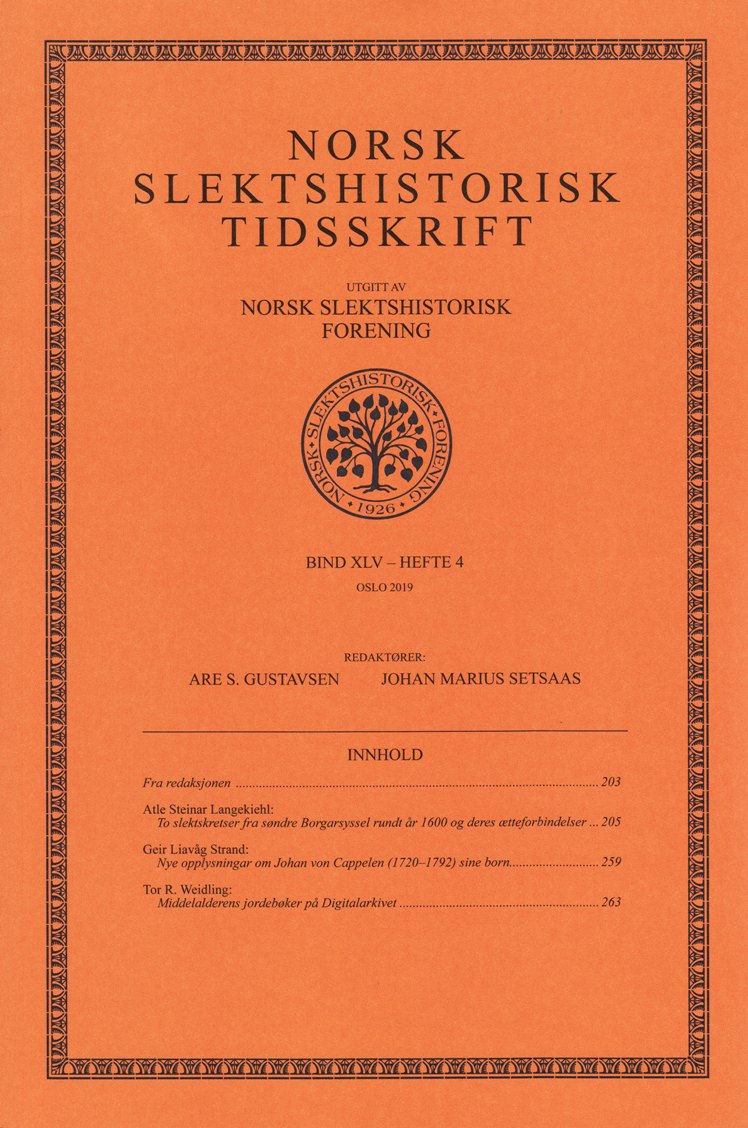
Norsk Slektshistorisk Tidsskrift, bind XLV, hefte 4


Siste utgave av Norsk Slektshistorisk Tidsskrift (bind XLV (45), hefte 4), som utgis av Norsk Slektshistorisk Forening, kom endelig i postkassen tidligere denne uken. NST kunne denne gangen by på:
  • Fra redaksjonen, s. 203.
  • Atle Steinar Langekiehl: To slektskretser fra søndre Borgarsyssel rundt år 1600 og deres ætteforbindelser, s. 205.
  • Geir Liavåg Strand: Nye opplysningar om Johan von Cappelen (1720–1792) sine born, s. 259.
  • Tor R. Weidling: Middelalderens jordebøker på Digitalarkivet, s. 263.
Temaet for hovedartikkelen er forbindelsene mellom to slektskretser fra hhv. Rolvsøy og Hvaler i søndre Borgarsyssel (den sørlige delen av dagens Østfold). Artikkelen har en god metodisk fremstilling, men er lett å lese og har for øvrig 6 slektstavler og en rekke illustrasjoner.

Geir Liavåg Strand utga høsten 2017 sammen med Hans Cappelen, Guri Alme og Solveig Viseth boken Johan von Cappelen og arven etter han, og NST-artikkelen må ses som en oppsummering av denne. Artikkelen er kort, men likevel viktig, idet den etter gjennomgang av skiftet etter Johan korrigerer opplysninger gitt i Thomles Cappelen-bok fra 1896. Johan er for øvrig min 5xtippoldefar.

Avslutningsvis gjør Tor Weidling, som er historiker og førstearkivar ved Riksarkivet, rede for flere jordebøker som nå er digitalisert og publisert på Digitalarkivet (Bergens Kalvskinn, Biskop Eysteins Jordebok og Aslak Bolts jordebok med flere).

Summary in English: The article gives a short survey of the contents of the latest issue of Norsk Slektshistorisk Tidsskrift, a periodical published by Norsk Slektshistorisk Forening (The Norwegian Genealogical Society).

Updated on Tuesday 17 January 2023 at 21:20 (typo corrected).

UK: Christening at Windsor

Archie Mountbatten-Windsor (2 months old), the son of the Duke and Duchess of Sussex, was christened in the Private Chapel at Windsor Castle today. The ceremony was conducted by the Archbishop of Canterbury, Justin Welby.

There is nothing much to add, really.  3 days ago the media received a «Media advisory» informing that «The godparents, in keeping with their wishes, will remain private». In my opinion the Sussexes are still struggling with finding the right balance between their official role and their wish for privacy for their son. I am sure it will be sorted out eventually. Richard Palmer, royal correspondent of The Daily Express, claims that the Sussexes «are in breach of a legal requirement to make the names of Archie’s godparents available to the public». So maybe the names will be revealed later, some way or the other, just like with the place of Archie's birth.

After the christening two photos were released on Instagram. The family photo which was taken in the Green Drawing Room shows Duke and Duchess of Sussex sitting with their son Archie and with the Duchess of Cornwall on the left and the Duchess of Cambrigde on the right. Behind them were (from left to right) the Prince of Wales, Doria Ragland, Lady Jane Fellowes, Lady Sarah McCorquodale (the last two sisters of Diana, Princess of Wales) and the Duke of Cambridge.

The two photos were accompanied with a short text, which among others said:
The Duke and Duchess of Sussex are so happy to share the joy of this day with members of the public who have been incredibly supportive since the birth of their son. They thank you for your kindness in welcoming their first born and celebrating this special moment.

Their Royal Highnesses feel fortunate to have enjoyed this day with family and the godparents of Archie.

Their son, Archie, was baptised wearing the handmade replica of the royal christening gown which has been worn by royal infants for the last 11 years. The original Royal Christening Robe, made of fine Honiton lace lined with white satin, was commissioned by Queen Victoria in 1841 and first worn by her eldest daughter. It was subsequently worn for generations of Royal christenings, including The Queen, her children and her grandchildren until 2004, when The Queen commissioned this handmade replica, in order for the fragile historic outfit to be preserved, and for the tradition to continue.